







16/04/2026
Share

Keywords: Augmented Reality (AR); Technology usage behavior; Learner attitudes; Personal innovation; Technology anxiety; Learning experience; Digital education; University students.
Technology is changing the way we learn every day, but not all technologies are truly embraced by students. Augmented reality (AR) is expected to bring more intuitive and vibrant learning experiences, but are students really ready to use it in their studies?
A group of students from the University of Economics Ho Chi Minh City (UEH) conducted a study titled "When education meets augmented reality: the research of UEH college of technology and design students’ intention to use augmented reality (AR) in the learning process" to explore the factors influencing attitudes and intentions to use AR in students' learning, especially in the context of technology increasingly becoming an indispensable part of modern education.
The biggest barrier to AR is not the difficulty of the tool, but the psychological knots of the learner.
First, it is not the new technology that excites students, but rather their belief that it truly helps them learn better. When students feel that using AR can improve their learning efficiency, help them understand the material faster or more intuitively, they will develop a positive attitude toward this technology. In other words, it is the value that the technology brings that makes them willing to embrace it, not the mere "modernity" of it.
Next, the surrounding environment also plays a significant role in shaping students' attitudes. When friends, instructors, or the learning community start using and appreciating AR, students tend to feel that using this technology is "normal" and should be tried. It is these social influences that create an invisible push, making the adoption of technology more acceptable.
Beside, it's not just those who are good at technology who want to use AR, but those who are willing to try something new will lead the way. Students who tend to enjoy exploration and are open to new technologies often develop a more positive attitude toward AR. At the same time, when they believe they can use technology effectively, they will be more confident and less hesitant during the experience.
However, an interesting factor is that just because something is easy to use doesn't mean students will like it. The research results show that whether AR is "easy to use" or not does not significantly affect attitudes. This reflects the reality that, for technology students, learning to use a new tool is not a significant barrier. What they care more about is whether the tool is really worth learning.
Ultimately, no matter how interested they are, the feeling of anxiety about technology can still slow down behavior. Students may be curious and willing to try AR, but there are still certain concerns when approaching a new technology. This "curiosity mixed with anxiety" indicates that for AR to be widely adopted, it is not only necessary to generate excitement but also to reduce psychological barriers during the experience.
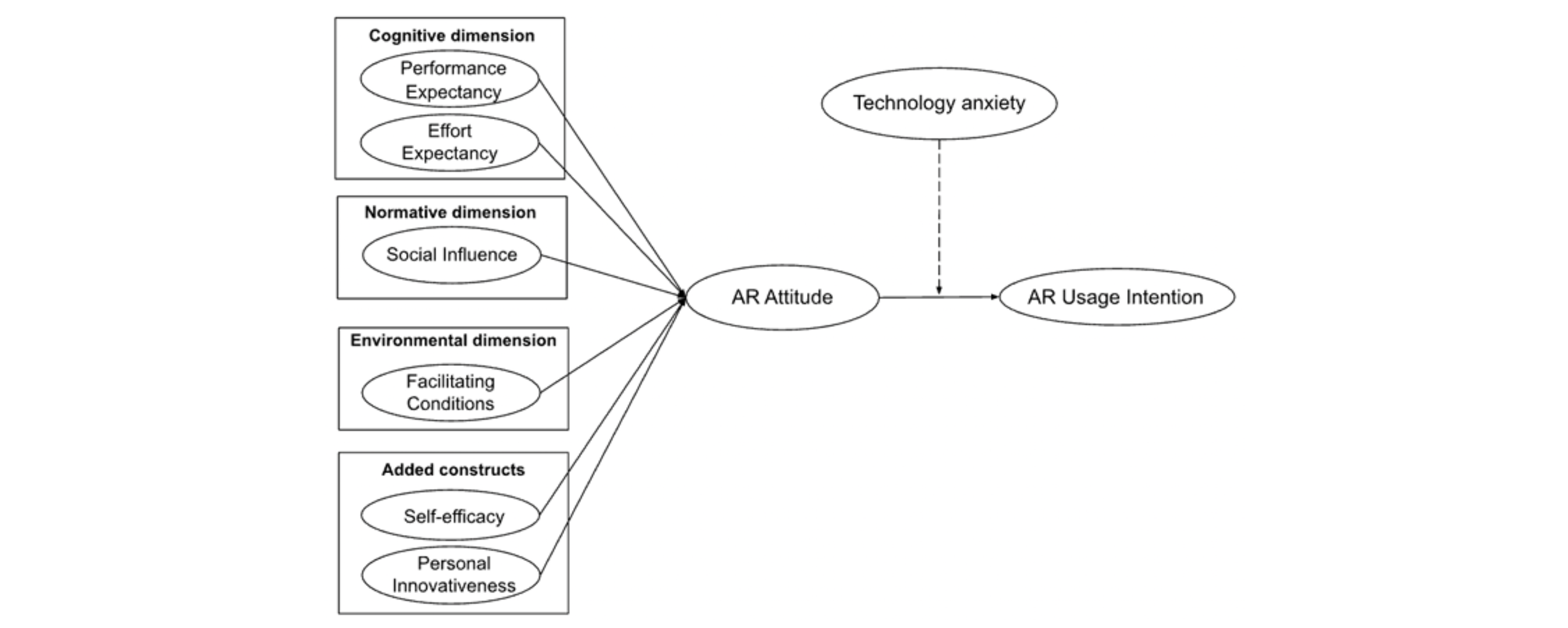
Research Model
From technology to experience: How can AR truly enter the classroom?
Research results have shown that integrating AR into education is not just about "having technology," but more importantly, creating clear learning value for students. When learners perceive that technology helps them understand the lesson better, learn faster, or have a more enjoyable experience, they will naturally develop a positive attitude and be willing to use it.
In addition, the human factor and learning environment also need to be leveraged. The proactive application of technology by instructors in teaching, combined with the ripple effect from friends and the community, can help AR become more familiar rather than just a "strange" tool. Once the use of technology becomes a normal part of the classroom, students will find it easier to access and maintain the behavior.
Additionally, instead of just focusing on making technology "user-friendly," universities should emphasize helping students see its true value. Practical, intuitive, and meaningful learning experiences will be the factors that retain learners for the long term, rather than just being demonstration tools.
Finally, in order for AR not to remain just an experiment, it is necessary to reduce the apprehension when approaching new technology. This can come from clear guidance, timely technical support, and creating a safe learning environment for students to experiment and make mistakes. The anxieties are reduced, and curiosity and a willingness to experiment will become the main driving forces behind the application of technology in learning.
The research paper has indirectly contributed to SDG 4, 9, and 13. View the full research paper “When education meets augmented reality: the research of UEH college of technology and design students’ intention to use augmented reality (AR) in the learning process” HERE
The authors: Mai Ngoc Doan Trinh, Nguyen Phuoc Quy Chau, Nguyen Truong Kieu Diem, Dang Tran Khanh Lam, To Bich Thuy - University of Economics Ho Chi Minh City.
This article is part of the Green Research Community series with the message “Research Contribution for UEH Living Lab Green Campus” UEH sincerely invites the community to follow the next Green Research Community newsletter.
|
*To create maximum conditions for the development of the “UEH Green Researcher Community” members of the community will be able to attend scientific research methods classes related to the topics of Living Lab and Green Campus. Additionally, upon meeting the standards, the research team will receive a certificate from the UEH Sustainable University Project Board and financial support for a standard-compliant project. |
More Information:
SDG 4 – Quality Education seeks to guarantee that everyone has access to fair, inclusive, and quality education at all levels. Education goes beyond providing basic knowledge; it opens opportunities for skill development, creative thinking, and social responsibility, thereby helping individuals adapt to global changes and contribute to sustainable development.
SDG 9 – Industry, Innovation, and Infrastructure aims to build resilient infrastructure, promote sustainable industrialization, and encourage innovation. This goal goes beyond advancing technology and production; it also includes narrowing infrastructure access gaps between regions, supporting small and medium-sized enterprises, and applying technology to enhance global competitiveness.
SDG 13 – Climate Action calls for urgent measures to combat climate change and its adverse impacts by reducing greenhouse gas emissions, enhancing adaptive capacity, and raising public awareness. This goal goes beyond national-level policies and requires changes in individual and community behaviors in daily life, especially in areas directly linked to waste generation and management.
News, photos: UEH Green Campus Project, UEH Youth Union - Student Association, UEH Communications and Partnership Development Department
Voiceover: Thanh Kieu

