







06/08/2026
Share

Keywords: Sustainable marketing; Brand image; Brand trust; Brand equity; Responsible sustainable consumer behavior; Gen Z, Green products.
Why do so many young people say they care about the environment, but when faced with the shelves, they still choose familiar products instead of "green" ones? Is the issue not in awareness, but in how brands convey sustainable messages to consumers? In the context of businesses increasingly investing in green marketing, the question is no longer "should we do sustainable marketing," but rather "how can we make consumers truly believe, genuinely feel, and ultimately change their behavior?"
From that perspective, a group of students from the University of Economics Ho Chi Minh City (UEH) conducted a study titled “Investigating the influence of sustainability marketing approaches on the responsible sustainable consumption behavior of Gen Z with a focus on green products,” aiming to explore how sustainable marketing not only directly influences but also thru brand image, trust, and brand value, to promote responsible consumption behavior among Gen Z.
What really makes Gen Z change their green consumption behavior?
*It's not enough to just say "green," what's important is whether users believe it or not
Sustainable marketing today is no longer about companies claiming to be environmentally friendly. Young people have heard it many times, so what they care more about is: is this brand trustworthy? When a brand conveys a clear, consistent, and well-founded message, users will gradually form a positive impression. That impression is the first step for them to open up, feel that this brand "seems okay," and start considering their choice.
*Brand image is not just for recognition, but for users to make decisions
In reality, consumers do not have the time to check whether a product is truly "green" or not. Therefore, they often rely on their perception of the brand to make quicker decisions. If a brand is associated with responsibility, trustworthiness, and meaning, it will be more likely to be chosen among countless other options. For Gen Z, brand image has almost become a "shortcut" in their thinking when they face a purchasing decision.
*But just feeling okay isn't enough, you have to believe for it to lead to action
There is a clear gap between "feeling okay" and "truly believing." Consumers only take action when they believe that the brand is genuinely doing something, not just talking for the sake of it. This trust comes from transparency, consistency, and how the business fulfills its environmental commitments. Once trust is established, users will feel more at ease, and choosing green products will no longer be an experimental decision.
*Brand value is what keeps behavior lasting long-term
After making a choice, what makes consumers return or not lies in the value they perceive from the brand. If they feel their choice is worthwhile, is "right," then that behavior will not stop at just one time. Gradually, green consumption is no longer a special choice, but becomes a natural habit in life.
*Green consumption behavior does not come from a single factor, but from a whole process
The interesting point of the research is that behavior is not influenced by a single factor, but is formed thru multiple layers of different perceptions. Sustainable marketing creates an image, the image helps build trust, trust leads to a perception of value, and it is this process that truly drives responsible consumer behavior. When everything is connected well enough, consumers no longer feel persuaded; they simply naturally choose what is "greener."
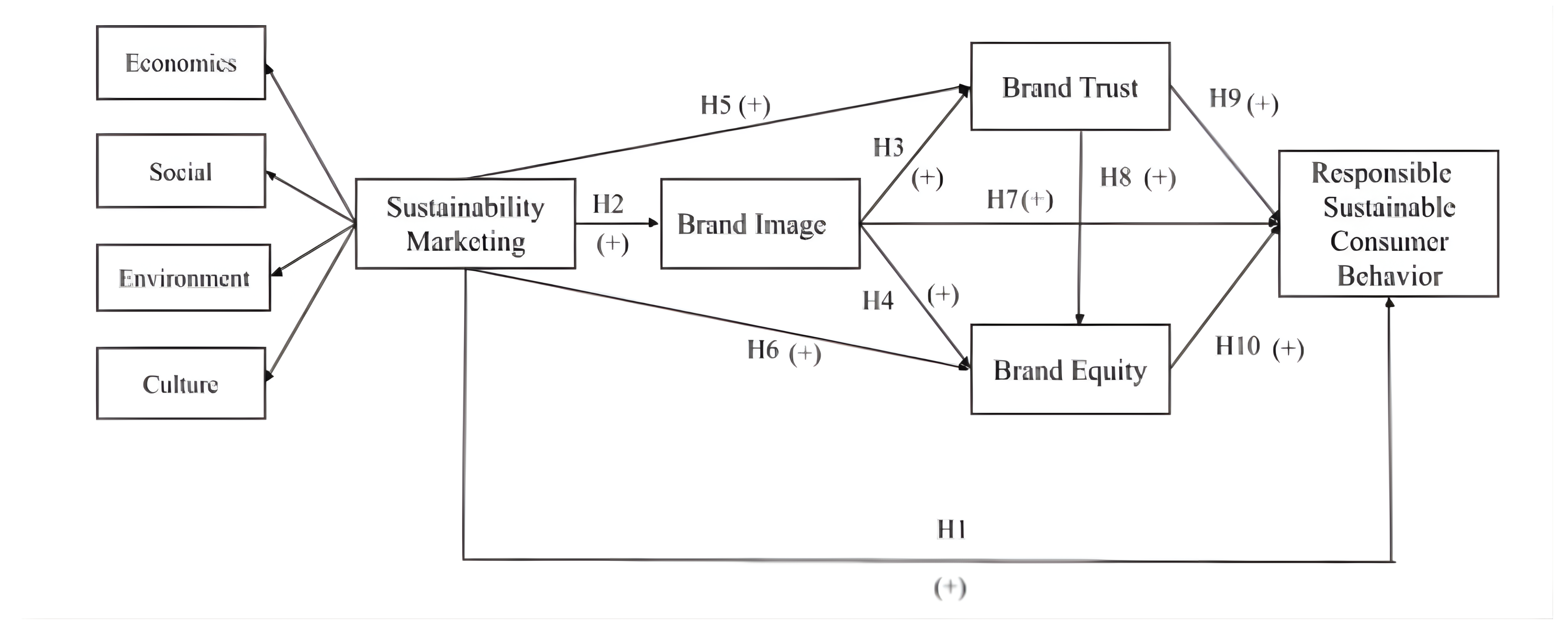
Research Model
From message to behavior: How can green marketing truly have an impact?
Sustainable marketing will not be effective if it only stops at beautiful communication. The important thing is not what the business says, but what consumers perceive afterward.
First, businesses need to build a clear and consistent brand image, so that when consumers think of it, they can immediately associate it with "trustworthy" and "responsible." This is the foundational step, because without a strong image, users will have no reason to trust from the beginning.
Next, trust needs to be reinforced by real actions, not just by messages. What the brand commits to must be clearly, transparently, and repeatedly demonstrated enough for consumers to feel assured in their choice.
Finally, to ensure that green consumer behavior does not stop at just one trial, businesses need to create sufficiently clear value for users to feel that their choice is worthwhile. When consumers both believe and see value, they will not only choose once, but also return and maintain that behavior for a long time.
In other words, if businesses want consumers to live sustainably, they cannot just "tell a green story," but must design a convincing enough experience for users to believe, choose, and stay.
The research paper has indirectly contributed to SDG 9, 12, and 13. View the full research paper “Investigating the influence of sustainability marketing approaches on the responsible sustainable consumption behavior of Gen Z with a focus on green products” HERE
The authors: Nguyen Thanh Ngan, Thuong Nguyen Tra Giang, Nguyen Phan Khanh Huyen, Nguyen Thi Thuy Hang, Nguyen Truc Hoang Nguyen - University of Economics Ho Chi Minh City.
This article is part of the Green Research Community series with the message “Research Contribution for UEH Living Lab Green Campus” UEH sincerely invites the community to follow the next Green Research Community newsletter.
|
*To create maximum conditions for the development of the “UEH Green Researcher Community” members of the community will be able to attend scientific research methods classes related to the topics of Living Lab and Green Campus. Additionally, upon meeting the standards, the research team will receive a certificate from the UEH Sustainable University Project Board and financial support for a standard-compliant project. |
More Information:
SDG 9 – Industry, Innovation, and Infrastructure aims to build resilient infrastructure, promote sustainable industrialization, and encourage innovation. This goal goes beyond advancing technology and production; it also includes narrowing infrastructure access gaps between regions, supporting small and medium-sized enterprises, and applying technology to enhance global competitiveness.
SDG 12 – Responsible Consumption and Production focuses on ensuring sustainable production and consumption patterns, thereby reducing pressure on natural resources, minimizing waste, and limiting environmental pollution. This goal emphasizes the importance of effective waste management, optimal use of resources, and promoting changes in consumer behavior at both individual and community levels, particularly through education and awareness.
SDG 13 – Climate Action calls for urgent measures to combat climate change and its adverse impacts by reducing greenhouse gas emissions, enhancing adaptive capacity, and raising public awareness. This goal goes beyond national-level policies and requires changes in individual and community behaviors in daily life, especially in areas directly linked to waste generation and management.
News, photos: UEH Green Campus Project, UEH Youth Union - Student Association, UEH Communications and Partnership Development Department
Voiceover: Thanh Kieu

