






13/09/2026
Share

Keywords: ESG; Financial flexibility; Sustainable development; Listed companies; Corporate governance; Developing Asia.
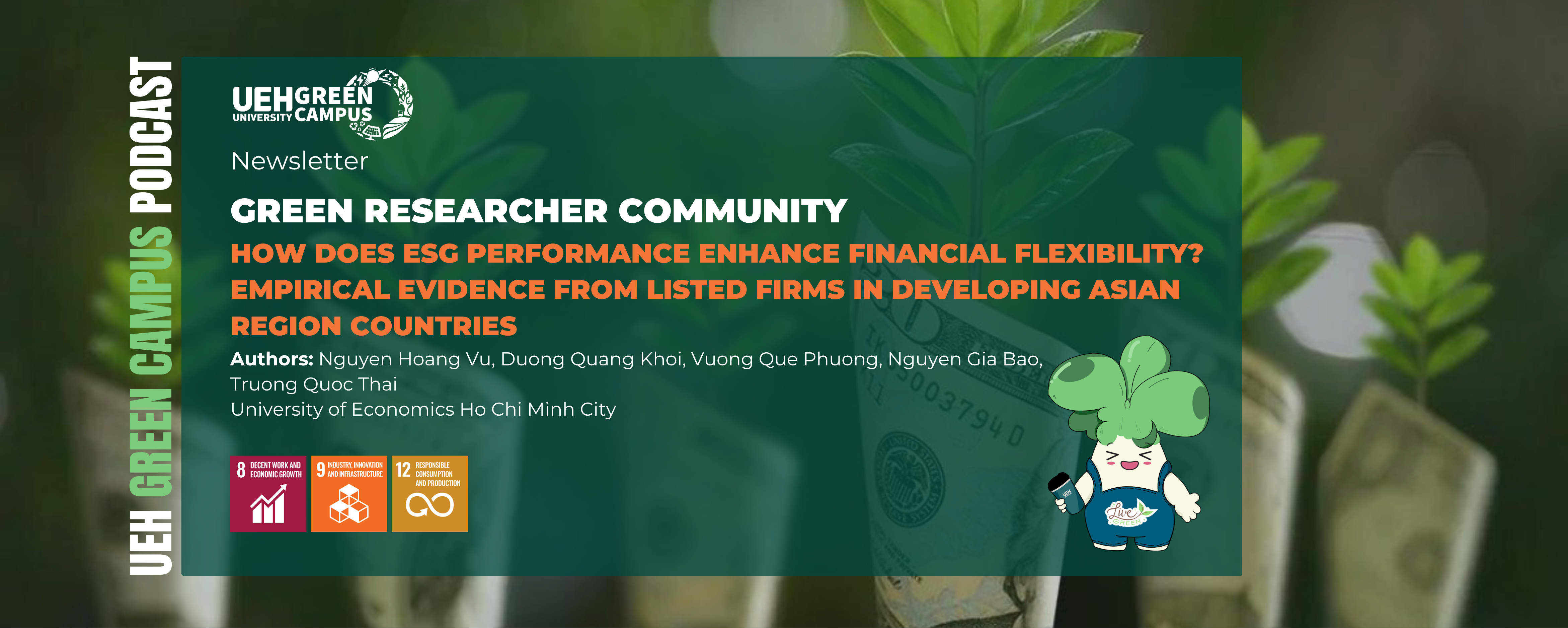
ESG not only demonstrates responsibility toward the environment and society but can also help businesses strengthen their financial foundation against fluctuations. Analyzing data from 199 listed companies in developing Asian countries during the period 2017–2021, a study by a group of students from the University of Economics Ho Chi Minh City (UEH) shows that ESG practices have a positive correlation with financial flexibility, thereby helping businesses adapt to risks and proactively seize growth opportunities.
In recent years, ESG has increasingly attracted the attention of many businesses as a direction for sustainable development. This is a set of criteria for evaluating businesses based on three aspects: Environmental, Social, and Governance. The effective implementation of ESG not only reflects the company's responsibility toward stakeholders but also sends a signal about transparency, governance capability, and long-term development orientation.
However, the focus of this research is not on ESG itself, but on a more important concept: financial flexibility. According to the authors, this is the ability of a business to proactively adapt to fluctuations in the business environment, maintain sufficient financial resources to withstand periods of instability, and be ready to seize investment opportunities when the market changes. A business with high financial flexibility not only has the ability to raise capital at a reasonable cost when needed but can also minimize the impact of economic shocks, maintain stable operations, and prepare resources for future growth. Therefore, in the context of a world continuously facing crises and uncertainties, financial flexibility is increasingly seen as one of the important foundations that help businesses develop sustainably.
Is ESG a "cushion" that helps businesses overcome crises?
Research results show that companies that implement ESG well often have higher financial flexibility. Thanks to their ability to maintain resources and access capital when needed, businesses can proactively respond to fluctuations, mitigate the impact of difficult periods, and be ready to seize new investment opportunities. ESG, therefore, not only creates value in terms of environmental and social aspects but also contributes to strengthening the financial foundation for long-term development.
This role becomes even more evident during unstable periods such as the COVID-19 pandemic or when the economy faces major shocks. Consistent implementation of ESG can help businesses build trust with stakeholders, reduce information asymmetry, enhance reputation, and improve access to capital. These are important advantages for businesses to maintain operations, manage risks, and better adapt to market changes.
From that perspective, ESG should be viewed as an investment in resilience rather than just a compliance cost. Although implementation may create additional financial pressure in the short term, especially for businesses in developing countries, the accumulated values of reputation, investor trust, and resource mobilization can bring more sustainable benefits in the long run.
Turning ESG into a competitive advantage in times of uncertainty
To harness these benefits, businesses need to integrate environmental, social, and governance criteria into their development strategies instead of viewing ESG as a mere formal requirement. Consistent implementation will contribute to enhancing reputation, strengthening stakeholder trust, expanding access to capital, and increasing financial flexibility. For developing countries, establishing mechanisms to promote ESG is also a necessary direction to attract responsible capital flows, enhance the competitiveness of businesses, and lay the foundation for sustainable growth.
The research paper has indirectly contributed to SDG 8, 9, and 12. View the full research paper “How does esg performance enhance financial flexibility? Empirical evidence from listed firms in developing Asian region countries” HERE
The authors: Nguyen Hoang Vu, Duong Quang Khoi, Vuong Que Phuong, Nguyen Gia Bao, Truong Quoc Thai - University of Economics Ho Chi Minh City.
This article is part of the Green Research Community series with the message “Research Contribution for UEH Living Lab Green Campus” UEH sincerely invites the community to follow the next Green Research Community newsletter.
|
*To create maximum conditions for the development of the “UEH Green Researcher Community” members of the community will be able to attend scientific research methods classes related to the topics of Living Lab and Green Campus. Additionally, upon meeting the standards, the research team will receive a certificate from the UEH Sustainable University Project Board and financial support for a standard-compliant project. |
More Information:
SDG 8 – Decent Work and Economic Growth focuses on building an inclusive economy that generates quality, fair, and sustainable jobs for all. This is not only about driving GDP growth but also about improving working conditions, expanding opportunities for youth and women, encouraging innovation, and developing businesses that integrate social responsibility.
SDG 9 – Industry, Innovation, and Infrastructure aims to build resilient infrastructure, promote sustainable industrialization, and encourage innovation. This goal goes beyond advancing technology and production; it also includes narrowing infrastructure access gaps between regions, supporting small and medium-sized enterprises, and applying technology to enhance global competitiveness.
SDG 12 – Responsible Consumption and Production focuses on ensuring sustainable production and consumption patterns, thereby reducing pressure on natural resources, minimizing waste, and limiting environmental pollution. This goal emphasizes the importance of effective waste management, optimal use of resources, and promoting changes in consumer behavior at both individual and community levels, particularly through education and awareness.
News, photos: UEH Green Campus Project, UEH Youth Union - Student Association, UEH Communications and Partnership Development Department
Voiceover: Thanh Kieu

