






28/04/2026
Share

Keywords: Sustainable information disclosure; ESG; Listed companies; Information transparency; Government pressure; Shareholder pressure; Stock market; Sustainability reporting; Corporate social responsibility; Sustainable development.
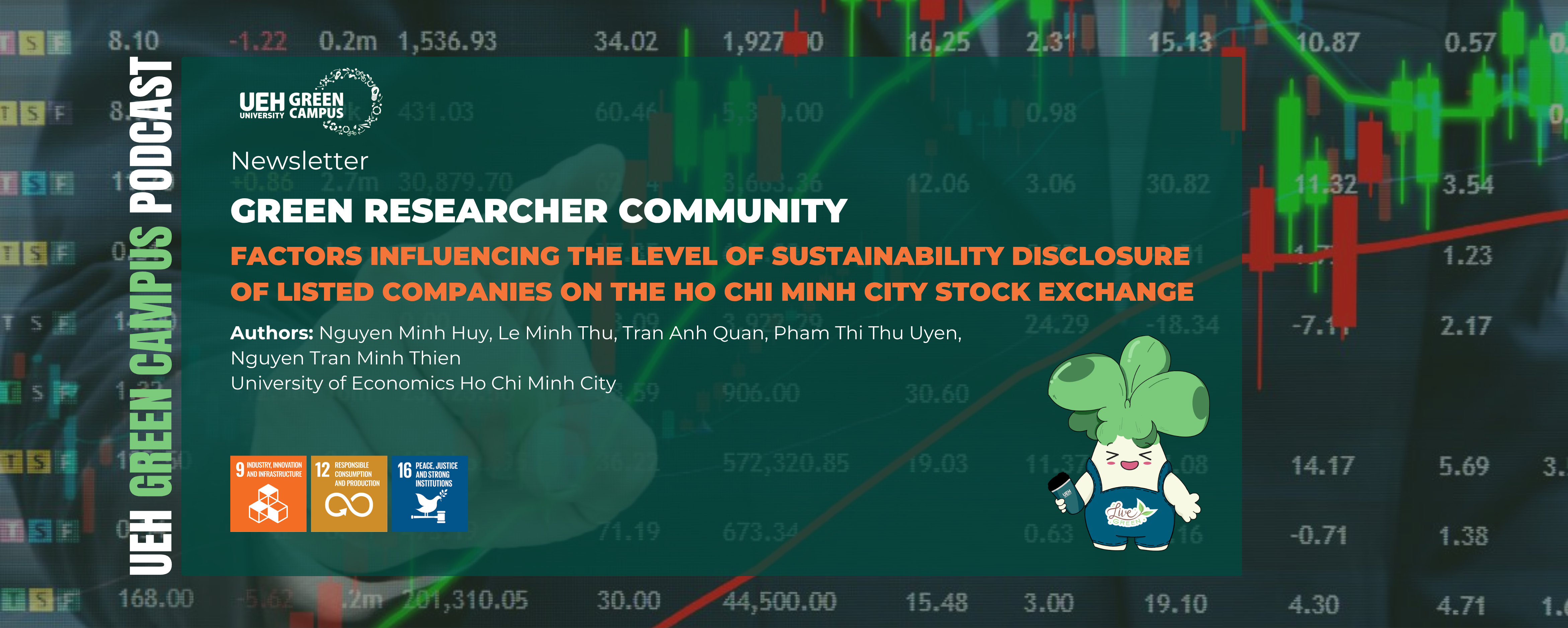
When sustainable development gradually becomes the "new game" in the marketplace, disclosing information is not only an obligation but also a commitment to corporate reputation. However, does that transparency stem from strategic vision or is it merely a consequence of invisible pressures? In search of an answer to this question, a group of students from the University of Economics Ho Chi Minh City (UEH) has launched a project titled "Factors influencing the level of sustainability disclosure of listed companies on the Ho Chi Minh City stock exchange" The research serves as a realistic lens, illuminating the barriers and underlying motivations that are shaping ESG disclosure behavior in Vietnam today.
Are companies transparent because they want to be, or because they have to be?
Transparency in sustainable development is often seen as a sign of a responsible business. But in reality, this behavior does not always stem from voluntary actions; it is largely influenced by external pressures. It is worth mentioning that not all pressures promote transparency; in fact, some factors can even create a reverse effect.
*When pressure from the government has not yet created real motivation
The research results show that pressure from the government has a negative impact on the level of sustainable development information disclosure. Instead of being proactive in transparency, businesses tend to disclose information in a "compliance" manner. When regulations are mandatory but lack clear incentives, disclosures can easily become superficial, lacking depth and not accurately reflecting the true nature of the company's sustainable operations.
*Shareholders: financial incentives can overshadow sustainability goals
Unlike expectations, pressure from shareholders does not promote transparency but tends to reduce the level of information disclosure. In the context where many shareholders still prioritize short-term financial performance, businesses may limit the sharing of information related to environmental costs or activities that have not yet yielded clear benefits. This makes transparency a considered choice rather than a long-term commitment.
*Market pressure does not automatically translate into change
One noteworthy point is that factors such as creditors, competitors, or foreign ownership ratios do not significantly influence information disclosure behavior. This shows that if stakeholders do not truly prioritize sustainable development, businesses will also find it difficult to change. Transparency at that point is not a common standard, but merely a matter of choice.
From pressure to motivation: When transparency needs to be "activated" correctly
Research indicates that transparency in sustainable development in Vietnam has not truly originated from within the enterprises, but is largely influenced by external pressures. Therefore, if it only stops at increasing regulations or controls, businesses are very likely to fall into a state of superficial announcements, lacking depth.
To change this, policies need to shift from "forcing" to "incentivizing." Instead of merely requiring businesses to disclose, it is necessary to accompany this with incentive mechanisms such as benefits, transparency rankings, or linking it to access to capital. When businesses see clear benefits, transparency will no longer be an obligation but will become part of their long-term development strategy.
In addition, the role of investors and shareholders also needs to be redefined. When these parties evaluate businesses not only thru profits but also thru environmental and social responsibilities, the pressure will transform into positive motivation. At that point, businesses will no longer "disclose to cope," but will proactively be transparent to build reputation and sustainable competitive advantage.
Finally, transparency only truly matters when it accurately reflects the nature of the company's operations. And to achieve that, an ecosystem is needed where policies, markets, and investors all promote a common standard for sustainable development.
The research paper has indirectly contributed to SDG 9, 12, and 16. View the full research paper “Factors influencing the level of sustainability disclosure of listed companies on the Ho Chi Minh City stock exchange ” HERE
The authors: Nguyen Minh Huy, Le Minh Thu, Tran Anh Quan, Pham Thi Thu Uyen, Nguyen Tran Minh Thien - University of Economics Ho Chi Minh City.
This article is part of the Green Research Community series with the message “Research Contribution for UEH Living Lab Green Campus” UEH sincerely invites the community to follow the next Green Research Community newsletter.
|
*To create maximum conditions for the development of the “UEH Green Researcher Community” members of the community will be able to attend scientific research methods classes related to the topics of Living Lab and Green Campus. Additionally, upon meeting the standards, the research team will receive a certificate from the UEH Sustainable University Project Board and financial support for a standard-compliant project. |
More Information:
SDG 9 – Industry, Innovation, and Infrastructure aims to build resilient infrastructure, promote sustainable industrialization, and encourage innovation. This goal goes beyond advancing technology and production; it also includes narrowing infrastructure access gaps between regions, supporting small and medium-sized enterprises, and applying technology to enhance global competitiveness.
SDG 12 – Responsible Consumption and Production focuses on ensuring sustainable production and consumption patterns, thereby reducing pressure on natural resources, minimizing waste, and limiting environmental pollution. This goal emphasizes the importance of effective waste management, optimal use of resources, and promoting changes in consumer behavior at both individual and community levels, particularly through education and awareness.
SDG 16 – Peace, Justice, and Strong Institutions centers on building peaceful societies, reducing violence and conflict, and ensuring equal access to justice for all. It also promotes transparent, accountable, and effective institutions that build public trust, thereby strengthening the foundation for sustainable development.
News, photos: UEH Green Campus Project, UEH Youth Union - Student Association, UEH Communications and Partnership Development Department
Voiceover: Thanh Kieu

