






19/04/2026
Share

Keywords: Gamification; Active learning; Learning effectiveness; Learning motivation; Learning experience; Competition; Rewards; Learning enthusiasm; Learning applications; University students.
Studying today no longer takes place solely in the classroom, but is gradually shifting to self-learning platforms. In that context, gamification elements have been incorporated into learning to make it more engaging. But does "learning while playing" really help students improve their learning effectiveness, or does it just make the experience more enjoyable? To provide convincing answers to these concerns, a group of students from the University of Economics Ho Chi Minh City (UEH) conducted a study titled "Analyzing the effect of gamification on learning effectiveness through applications for self-directed learning: Using elements of the ARCS model," aiming to clarify the effects of gamification on students' motivation and learning effectiveness in a self-directed learning environment.
What really makes gamification help students learn more effectively?
It's not that "playing" will make you learn better, but rather the way games create new motivation that determines learning effectiveness. So in gamification, what factors truly make a difference?
*Rewards are not just for "fun," but to keep learners going
In a self-learning environment, where there is no direct supervision, maintaining motivation is a significant challenge. Factors such as points, badges, or feedback serve as a "nudge" to help students feel that their efforts are recognized. When each learning action is accompanied by a clear reward, learners will continue to participate instead of giving up halfway.
*Competition does not create pressure, but rather motivation to strive harder
Instead of studying alone, gamification places students in an environment of comparison and interaction. Rankings or scores not only help learners know where they stand but also stimulate the desire to improve their position. It is this "gentle" competition that encourages students to spend more time studying and to make more proactive efforts to achieve good results.
*Interest is not a secondary factor; it is what keeps learners engaged
A boring learning experience is very difficult to maintain in a self-study environment. When the lessons are designed with images, sounds, stories, or clear goals, learners no longer feel like they are "studying," but rather like they are embarking on a journey. This sense of excitement helps increase concentration levels and makes it easier for learners to stay committed to the learning process for a longer time.
*To learn better, first, you must make the learner "want to learn"
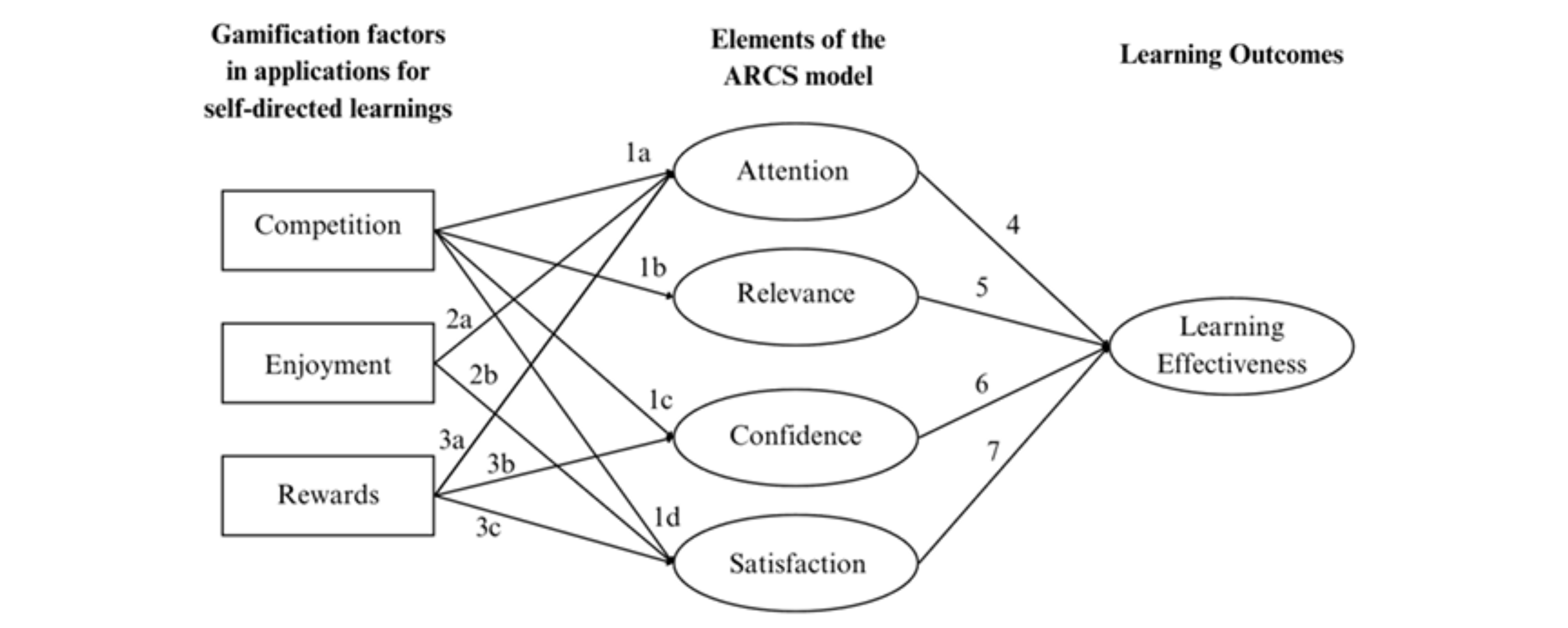
Gamification elements do not directly impact learning outcomes, but rather thru an "intermediate layer" of motivation. When learners feel more attentive, find the content more relevant, feel more confident, and are more satisfied during the learning process, the effectiveness of learning truly improves. This shows that the issue does not lie in whether or not there is technology, but in how technology is designed to resonate with the learner's psychology.
 Research Model
When learning becomes an experience: The key to making gamification truly effective
Through research, it can be seen that gamification is not simply about adding points or leaderboards to the learning process, but rather about designing the learning experience around the learner's motivation. Once elements such as competition, rewards, and excitement are used correctly, they not only make learning more engaging but also activate focus, a sense of relevance, confidence, and satisfaction in the learning process.
This suggests that educational institutions and app developers should not stop at merely "gamifying for the sake of it," but rather understand what learners need in their self-directed learning journey. An effective system is one that makes learners feel progress, recognized, and have reasons to continue, rather than simply providing short-term entertainment.
In addition, the design of competitive elements also needs to be considered in a positive direction. Competition should not create pressure, but rather become a mechanism to encourage effort and maintain participation. When learners feel they can improve and control the outcomes, that is when they will be more proactive in their learning.
Finally, to truly enhance learning effectiveness thru gamification, the focus needs to shift from "making it fun" to "making it meaningful." When the learning experience is both enjoyable and relevant to the learner's personal goals, motivation will be sustained over the long term, and thus, the effectiveness of learning will truly improve.
The research paper has indirectly contributed to SDG 4, 8, and 9. View the full research paper “Analyzing the effect of gamification on learning effectiveness through applications for self-directed learning: Using elements of the ARCS model” HERE
The authors: Nguyen Thanh Hai, Vo Duc Nghia, Le Nguyen Chau Anh, Dinh Bao Ngoc - University of Economics Ho Chi Minh City.
This article is part of the Green Research Community series with the message “Research Contribution for UEH Living Lab Green Campus” UEH sincerely invites the community to follow the next Green Research Community newsletter.
|
*To create maximum conditions for the development of the “UEH Green Researcher Community” members of the community will be able to attend scientific research methods classes related to the topics of Living Lab and Green Campus. Additionally, upon meeting the standards, the research team will receive a certificate from the UEH Sustainable University Project Board and financial support for a standard-compliant project. |
More Information:
SDG 4 – Quality Education seeks to guarantee that everyone has access to fair, inclusive, and quality education at all levels. Education goes beyond providing basic knowledge; it opens opportunities for skill development, creative thinking, and social responsibility, thereby helping individuals adapt to global changes and contribute to sustainable development.
SDG 8 – Decent Work and Economic Growth focuses on building an inclusive economy that generates quality, fair, and sustainable jobs for all. This is not only about driving GDP growth but also about improving working conditions, expanding opportunities for youth and women, encouraging innovation, and developing businesses that integrate social responsibility.
SDG 9 – Industry, Innovation, and Infrastructure aims to build resilient infrastructure, promote sustainable industrialization, and encourage innovation. This goal goes beyond advancing technology and production; it also includes narrowing infrastructure access gaps between regions, supporting small and medium-sized enterprises, and applying technology to enhance global competitiveness.
News, photos: UEH Green Campus Project, UEH Youth Union - Student Association, UEH Communications and Partnership Development Department
Voiceover: Thanh Kieu

