






07/03/2026
Share

Keywords: SDGs and the banking sector, Sustainable banking, Bank customers and SDGs, Banking sector and SDGs, Customer satisfaction, trust, and loyalty.
In the context where banks compete not only with interest rates or technology but also with social and environmental responsibility, an important question arises: do sustainable development strategies truly impact customer perceptions and behaviors? When banks invest in the community, protect the environment, and enhance social responsibility, do customers trust more, feel more satisfied, and are more willing to stay long-term? And what factors make a difference: brand image, pricing, or service experience?
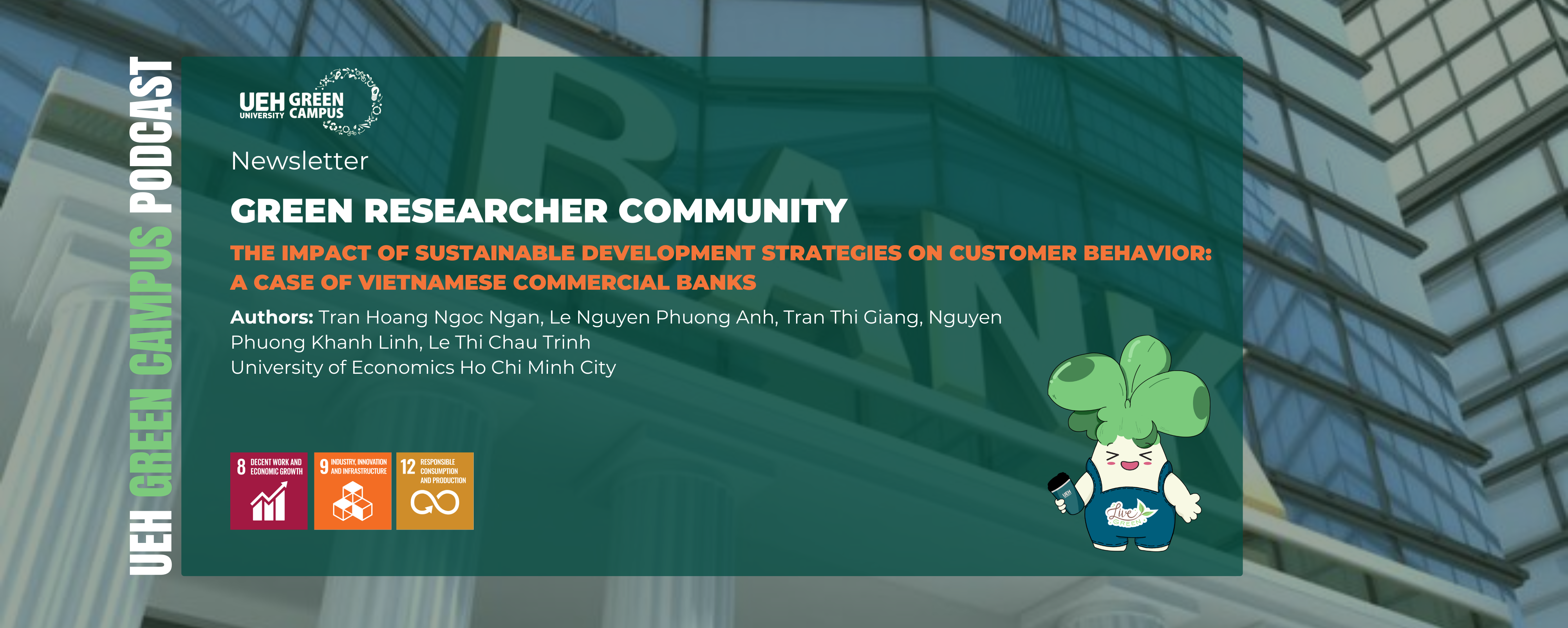
From those issues, a group of students from the University of Economics Ho Chi Minh City conducted a research project titled "The impact of sustainable development strategies on customer behavior: A case of vietnamese commercial banks" to clarify how sustainable development truly shapes customer decisions and loyalty today.
The bank's sustainable development strategy
The bank's sustainable development strategy is not just about social sponsorship activities or individual charitable programs, but rather a long-term approach linked to three pillars: economic, social, and environmental. That is, the bank not only focuses on profit but also emphasizes transparency in business operations, creates value for the community, builds a responsible brand image, and aims for environmentally friendly practices and long-term sustainable development. These commitments, when consistently implemented, gradually become the "invisible message" that customers perceive in every service experience, every image, and the way the bank appears in social life.
Factors shaping how customers perceive and connect with the bank
In the journey of sustainable development, the impact of the bank on customers does not come immediately, but unfolds in layers of perception: from commitments at the strategic level, to how customers "translate" those commitments into personal images and emotions, before crystallizing into trust and long-term attachment to the bank's brand.
*Sustainable development is no longer just a slogan; it has become a perception in the eyes of customers
At the first layer of impact, sustainable development is perceived by customers thru three value directions: stability and transparency in economic activities; care for people and the community; and efforts toward the environment and a green future. These values do not appear as isolated statements, but gradually shape customers' initial perceptions of the bank's style, attitude, and "character" in daily service life.
*From surface-level commitments to internal perceptions: brand image and a sense of rationality
Those sustainable signals continue to be "transformed" by customers into two important layers of perception. First is the brand image – where the bank is perceived as a trustworthy organization, responsible and consistent with the values it pursues. Secondly, it is the perception of fairness in prices and service fees, not just in specific numbers, but in the feeling of fairness and worthiness of the value they receive in return. These two layers of perception create a bridge between sustainable development strategies and deeper emotions in the customer experience.
*When perception gradually transforms into emotion: satisfaction, trust, and commitment
From a positive brand image and a reasonable sense of value, satisfaction begins to form during the process of customers using the service. On that foundation, trust is gradually built over time—not just in the transaction process, but in the direction and responsibility that the bank chooses to pursue. And when trust is strong enough, loyalty becomes a natural choice: customers stay not just for convenience, but for the resonance of values and the way the bank accompanies them in their financial lives.

Research Model
Sustainable development is not just a responsibility, but a competitive advantage for banks to connect with customers
Research results show that the bank's commitments to sustainable development not only have social significance but also significantly impact how customers perceive the brand image, satisfaction, trust, and long-term loyalty. The values associated with economic, social, and environmental responsibility, when consistently maintained, gradually become the foundation for shaping positive customer emotions toward the bank.
From there, it can be seen that sustainable development is not only an organizational responsibility but also a strategic investment direction for the bank's image and customer relationships. When community, education, or environmental activities are carried out in depth and maintained over the long term, they no longer serve merely as communication roles but become identifying marks that help customers feel the bank is trustworthy and socially responsible.
Along with that, the brand image and the way the bank demonstrates consistency between its messages and actions play a very important role in reinforcing satisfaction and trust. When customers perceive transparency, clarity, and respect during the interaction and use of services, a sense of reassurance and goodwill will gradually be built over time.
Beside the image, the perception of the reasonableness of prices and service policies also contributes to shaping the customer experience. It's not just about the fees or interest rates, but the feeling of fairness and deserving the value they receive. When this factor is ensured, customers tend to maintain a stable and more committed relationship.
From a broader perspective, expanding cooperation with social organizations and stakeholders helps the bank extend its sustainable impact beyond its internal operations. In the eyes of customers, the bank is not just a provider of financial services, but also an active contributor to the community. And that very thing helps to further strengthen trust, empathy, and long-term commitment.
The research paper has indirectly contributed to SDG 8, 9, and 12. View the full research paper “The impact of sustainable development strategies on customer behavior: A case of vietnamese commercial banks” HERE
Authors: Tran Hoang Ngoc Ngan, Le Nguyen Phuong Anh, Tran Thi Giang, Nguyen Phuong Khanh Linh, Le Thi Chau Trinh - University of Economics Ho Chi Minh City.
This article is part of the Green Research Community series with the message “Research Contribution for UEH Living Lab Green Campus” UEH sincerely invites the community to follow the next Green Research Community newsletter.
|
*To create maximum conditions for the development of the “UEH Green Researcher Community” members of the community will be able to attend scientific research methods classes related to the topics of Living Lab and Green Campus. Additionally, upon meeting the standards, the research team will receive a certificate from the UEH Sustainable University Project Board and financial support for a standard-compliant project. |
More Information:
SDG 8 – Decent Work and Economic Growth focuses on building an inclusive economy that generates quality, fair, and sustainable jobs for all. This is not only about driving GDP growth but also about improving working conditions, expanding opportunities for youth and women, encouraging innovation, and developing businesses that integrate social responsibility.
SDG 9 – Industry, Innovation, and Infrastructure aims to build resilient infrastructure, promote sustainable industrialization, and encourage innovation. This goal goes beyond advancing technology and production; it also includes narrowing infrastructure access gaps between regions, supporting small and medium-sized enterprises, and applying technology to enhance global competitiveness.
SDG 12 – Responsible Consumption and Production focuses on ensuring sustainable production and consumption patterns, thereby reducing pressure on natural resources, minimizing waste, and limiting environmental pollution. This goal emphasizes the importance of effective waste management, optimal use of resources, and promoting changes in consumer behavior at both individual and community levels, particularly through education and awareness.
News, photos: UEH Green Campus Project, UEH Youth Union - Student Association, UEH Communications and Partnership Development Department
Voiceover: Thanh Kieu

