






12/06/2026
Share

Keywords: Financial development; Green finance; Foreign Direct Investment (FDI); CO2 emissions; Developing countries; Sustainable development; Renewable energy.
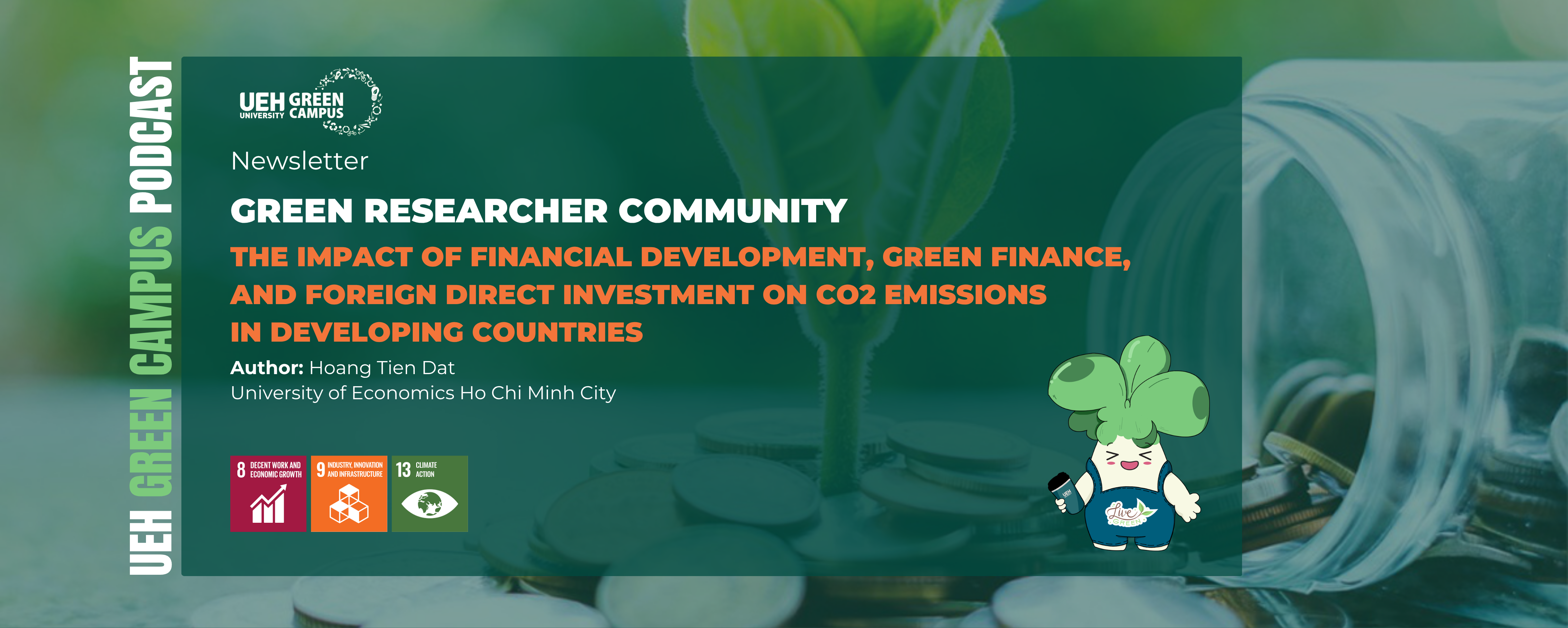
Economic growth, attracting FDI, and environmental protection: Is it possible to achieve all three? In order to solve this difficult problem in developing countries, a group of UEH students conducted a study titled "The impact of financial development, green finance, and foreign direct investment on CO2 emissions in developing countries" Analyzing data from 47 countries during the period 2005 - 2019, the study clearly illustrated how financial flows are putting pressure on the environment, while also pointing out the "escape route" called green finance.
First, financial development can drive growth, but it also brings environmental pressure. Financial development has an impact on increasing CO2 emissions in developing countries. As the financial system expands, access to loans becomes easier, businesses have more resources to increase production, and people also increase their consumption of energy-intensive products such as cars, air conditioners, and electronic devices. This leads to a significant increase in energy demand and consequently a larger amount of CO2 emissions.
Next, green finance is not just a trend, but it can create a real impact on the environment. In contrast to traditional financial development, research shows that green finance has an impact in reducing CO2 emissions. Investments in renewable energy, clean technology, or environmentally friendly projects are seen as factors that help countries reduce dependence on fossil fuels and alleviate emission pressure in the long term. According to the group of authors, this is also the reason why green finance is increasingly seen as an important tool in the sustainable development strategy of many countries.
In addition, FDI can bring economic growth, but it also carries the risk of "pollution export." Research also indicates that foreign direct investment (FDI) has an impact on increasing CO2 emissions in developing countries. Part of the reason is that many foreign companies tend to relocate their polluting production activities to countries with less stringent environmental standards. This causes developing countries to benefit from economic growth and job creation, while also facing increasing environmental pressure.
Ultimately, not all sources of capital have the same impact. A noteworthy point of the study is that although it is the same flow of financial capital, the impact on the environment is completely different depending on how that capital is used. If the flow of capital is directed into energy-intensive production sectors or polluting activities, CO2 emissions will continue to increase. Conversely, when capital is directed toward renewable energy, green technology, and sustainable projects, the financial system can become a tool for improving the environment rather than degrading it.
Thru this, the authors argue that developing countries need to pay more attention to the quality of capital flows rather than just focusing on the speed of economic growth. The expansion of financial markets or the attraction of foreign investment can bring many benefits to the economy, but without sustainable orientation, these sources of capital can also increase environmental pressure and CO2 emissions.
The study also emphasizes the role of green finance in the transition to a sustainable development model. Tools such as green bonds, investment in renewable energy, or financial support for clean technology projects are seen as solutions that help countries maintain economic growth while limiting negative environmental impacts.
Not only that, the group of authors believes that developing countries need to establish stricter environmental regulations for FDI enterprises to avoid becoming "pollution hotspots" for high-emission production activities. Instead of attracting investment at any cost, prioritizing projects that use clean technology and sustainable development could be an important direction in the long term.
The research paper has indirectly contributed to SDG 8, 9, and 13. View the full research paper “The impact of financial development, green finance, and foreign direct investment on CO2 emissions in developing countries” HERE
The authors: Hoang Tien Dat - University of Economics.
This article is part of the Green Research Community series with the message “Research Contribution for UEH Living Lab Green Campus” UEH sincerely invites the community to follow the next Green Research Community newsletter.
|
*To create maximum conditions for the development of the “UEH Green Researcher Community” members of the community will be able to attend scientific research methods classes related to the topics of Living Lab and Green Campus. Additionally, upon meeting the standards, the research team will receive a certificate from the UEH Sustainable University Project Board and financial support for a standard-compliant project. |
More Information:
SDG 8 – Decent Work and Economic Growth focuses on building an inclusive economy that generates quality, fair, and sustainable jobs for all. This is not only about driving GDP growth but also about improving working conditions, expanding opportunities for youth and women, encouraging innovation, and developing businesses that integrate social responsibility.
SDG 9 – Industry, Innovation, and Infrastructure aims to build resilient infrastructure, promote sustainable industrialization, and encourage innovation. This goal goes beyond advancing technology and production; it also includes narrowing infrastructure access gaps between regions, supporting small and medium-sized enterprises, and applying technology to enhance global competitiveness.
SDG 13 – Climate Action calls for urgent measures to combat climate change and its adverse impacts by reducing greenhouse gas emissions, enhancing adaptive capacity, and raising public awareness. This goal goes beyond national-level policies and requires changes in individual and community behaviors in daily life, especially in areas directly linked to waste generation and management.
News, photos: UEH Green Campus Project, UEH Youth Union - Student Association, UEH Communications and Partnership Development Department
Voiceover: Thanh Kieu

