







21/03/2026
Share

Keywords: Climate change; Shopping behavior; Organic food.
Climate change is no longer a distant threat; it has directly reshaped the consumer lens. As the line between personal health and environmental survival becomes increasingly intertwined, organic food has emerged as a new manifesto for a sustainable lifestyle. However, behind this growing trend, a core question arises: Are concerns about a warming Earth truly the decisive catalyst driving consumers' green food purchasing behavior?
From that question, a group of students from the University of Economics Ho Chi Minh City (UEH) conducted a research project titled “The effect of climate change on the behavior of buying organic food of consumers and businesses aims to sustainable development: case in Ho Chi Minh City.” The study focuses on analyzing how concerns about climate change can affect the perception, attitude, and purchasing behavior of organic food among consumers in Ho Chi Minh City, thereby clarifying the role of mediating factors such as environmental awareness and health perception in promoting sustainable consumption trends.
Is climate change changing the way we choose our food?
*Concern about climate change – the origin of environmental awareness
As extreme weather events, pollution, and environmental degradation become more frequent, climate change is gradually becoming an issue that many people cannot ignore. Research shows that when consumers become more aware of the negative impacts of climate change, they also become more concerned about environmental issues. This concern becomes the starting point for promoting environmentally friendly consumer choices, including the selection of organic food.
*Environmental awareness – a factor shaping attitudes toward organic food
When consumers become more concerned about the environment, they also start to appreciate products that are produced sustainably. Organic food, with its production process that limits chemicals and is eco-friendly, is therefore often viewed more positively. Research indicates that environmental awareness can directly influence consumers' attitudes toward organic food, thereby fostering support for "green" products.
*Health awareness – a key motivation behind purchasing decisions
Beyond environmental concerns, personal health is also one of the important factors driving consumers to choose organic food. When people become aware of the risks from chemically processed foods, many start turning to products that are considered safer and more nutritious. Therefore, when consumers believe that organic food brings health benefits, they are more likely to form a stronger intention to purchase these products.
*Purchase intention – the final step before the actual behavior occurs
In the consumer decision-making process, purchase intention plays a crucial mediating role before the actual purchase behavior occurs. When a positive attitude toward organic food is formed and health awareness is heightened, consumers will have the intention to purchase. And when that intention is strong enough, it will transform into actual purchasing behavior in daily life.
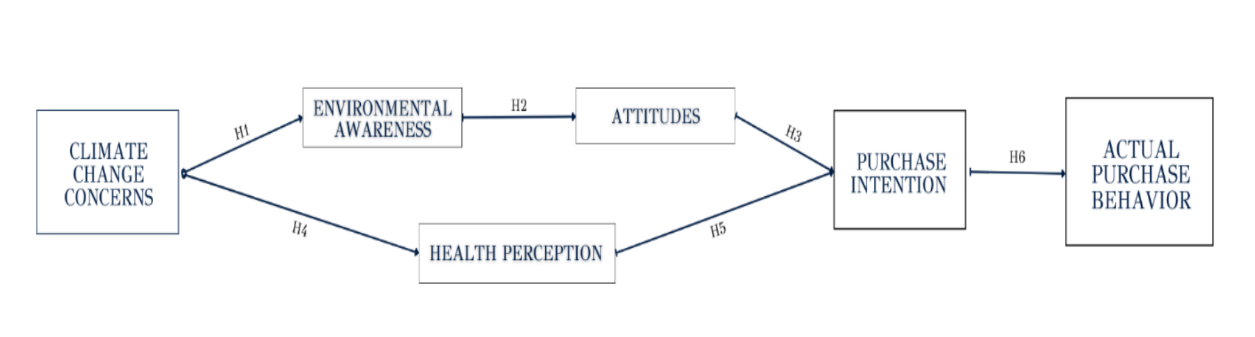 Research Model
Organic food and green consumption: steps toward sustainable development
From the research results, it can be seen that concerns about climate change are not only limited to awareness but can also influence the way consumers choose food in their daily lives. As consumers become increasingly concerned about the environment and personal health, organic food becomes a suitable choice in line with sustainable consumption trends. Therefore, to promote the development of this market, regulatory agencies need to establish policies supporting organic agriculture, while also enhancing information transparency in the supply chain to help consumers easily recognize and trust organic products.
In addition, businesses also play an important role in raising consumer awareness. Through communication, education, and transparent branding activities, businesses can help customers better understand the benefits of organic food for health and the environment. When consumers are provided with complete information and their trust in the product is reinforced, they will find it easier to make smarter purchasing decisions, contributing to the promotion of a sustainable consumption model in society.
The research paper has indirectly contributed to SDG 3, 12, and 13. See the full research paper “The effect of climate change on the behavior of buying organic food of consumers and businesses aims to sustainable development: case in Ho Chi Minh City” HERE
The authors: Phan Nguyen Ngoc Diem, Ngo Le Hoang Vu, Tran Thanh Hoa, Nguyen Kim Khanh, Bui Vo Thuy Tien - University of Economics Ho Chi Minh City.
This article is part of the Green Research Community series with the message “Research Contribution for UEH Living Lab Green Campus” UEH sincerely invites the community to follow the next Green Research Community newsletter.
|
*To create maximum conditions for the development of the “UEH Green Researcher Community”, members of the community will be able to attend scientific research methods classes related to the topics of Living Lab and Green Campus. Additionally, upon meeting the standards, the research team will receive a certificate from the UEH Sustainable University Project Board and financial support for a standard-compliant project. |
More Information:
SDG 3 – Good Health and Well-being emphasizes the importance of ensuring comprehensive health and improving the quality of life for people of all ages. This includes reducing maternal and child mortality, preventing epidemics, increasing access to essential healthcare services and medicines, as well as encouraging healthy lifestyles. A healthy society depends not only on modern healthcare systems but also on active community participation in creating safe and healthy living environments.
SDG 12 – Responsible Consumption and Production focuses on ensuring sustainable production and consumption patterns, thereby reducing pressure on natural resources, minimizing waste, and limiting environmental pollution. This goal emphasizes the importance of effective waste management, optimal use of resources, and promoting changes in consumer behavior at both individual and community levels, particularly through education and awareness.
SDG 13 – Climate Action calls for urgent measures to combat climate change and its adverse impacts by reducing greenhouse gas emissions, enhancing adaptive capacity, and raising public awareness. This goal goes beyond national-level policies and requires changes in individual and community behaviors in daily life, especially in areas directly linked to waste generation and management.
News, photos: UEH Green Campus Project, UEH Youth Union - Student Association, UEH Communications and Partnership Development Department
Voiceover: Thanh Kieu

