






03/05/2026
Share

Keywords: Eco-friendly packaging; Purchase intention; Gen Z; Theory of Planned Behavior; Altruistic values; Egoistic values; Environmental awareness; Health consciousness; Social norms; Control perceived behavior.
In the context of increasing environmental pollution, product packaging is becoming one of the "silent culprits" contributing to the enormous amount of waste generated each day. Although consumers, especially Gen Z, are increasingly concerned about the environment, choosing products with eco-friendly packaging has not yet truly become a common behavior. So what is driving, or hindering, this decision?
To find a solution to this problem, a group of students from the University of Economics Ho Chi Minh City (UEH) conducted a study titled "Study about gen z's purchase intention of using eco-friendly packaging in Ho Chi Minh City through the theory of planned behaviour (TPB) and altruistic - Egoistic values," based on the planned behavior model combined with an altruistic value system (environmental concern) and an egoistic value system (health concern), aiming to provide deeper insights into the motivations behind young people's green consumption behavior.
Ecological awareness is not enough to drive behavior; the key lies in an individual's belief in their own ability to act.
Although Gen Z is considered an environmentally conscious generation, the transition from awareness to actual purchasing behavior is not simple at all. The decision to choose eco-friendly packaging does not only stem from awareness but is also influenced by various psychological and social factors.
First, perceived behavioral control is the factor that has the strongest influence on purchase intention. Once consumers feel that choosing products with eco-friendly packaging is easy, financially feasible, and practically convenient, they are generally more willing to take action. Conversely, if they think that this choice is "difficult to implement," then even with environmental awareness, the behavior is still unlikely to occur.
Secondly, social norms are also an important factor driving purchase intentions. When friends, family, or the surrounding community support green consumption, Gen Z tends to be influenced and adjust their behavior accordingly. This shows that sustainable consumption is not only a personal choice but also a socially driven behavior.
Thirdly, altruistic values and self-interested values both positively influence attitudes and purchase intentions. However, the self-interested factor, specifically the concern for personal health, has a stronger impact. This shows that consumers not only act for the environment but also for their own direct benefit.
Fourth, attitudes toward eco-friendly packaging play an important mediating role. Because when consumers have a positive perception, they will be more likely to form a purchase intention. But to create that attitude, a combination of many factors from cognition, emotion to social influence is needed.
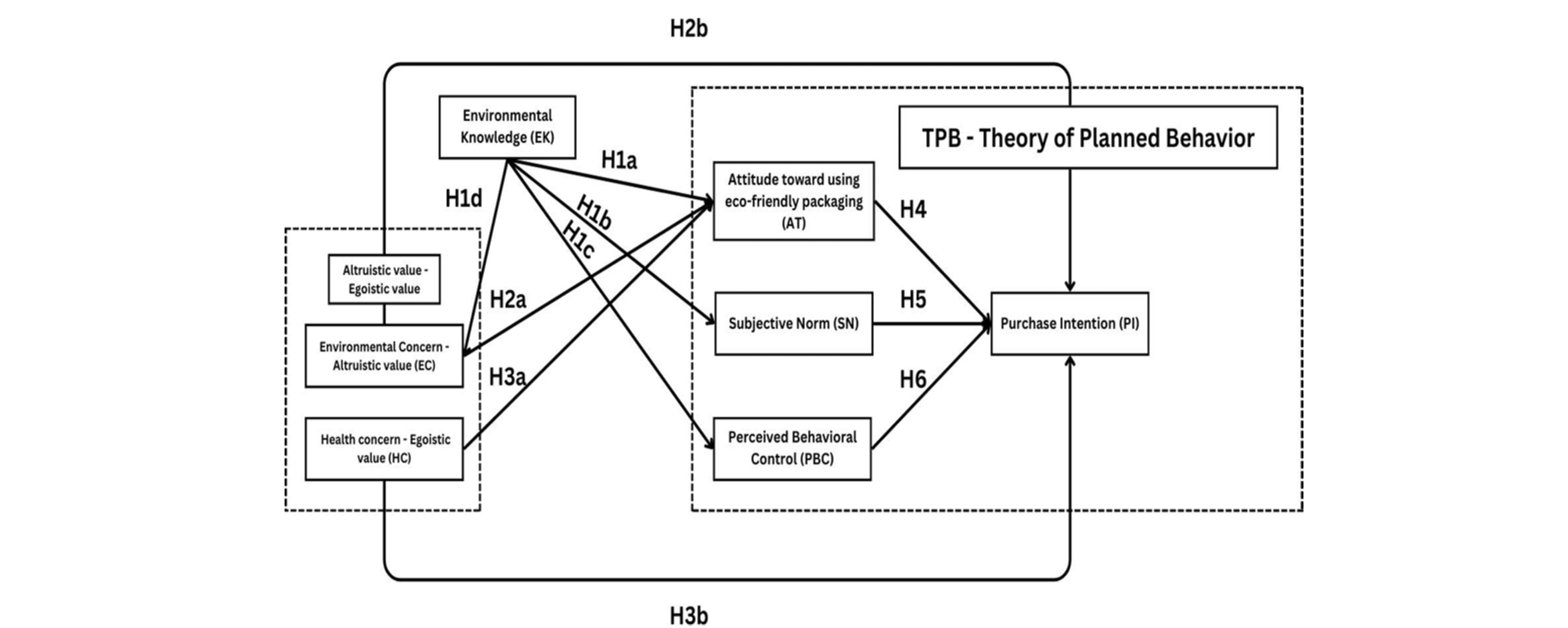
Research model
If you want Gen Z to live sustainably, don't just talk the talk, make it feel "easy to do" for them.
Research shows that promoting green consumption cannot be limited to raising awareness or calling for environmental responsibility. What is more important is making consumers feel that such behavior is truly feasible in their daily lives.
Therefore, businesses need to focus on reducing barriers instead of just increasing the message. Reasonable prices, easy accessibility, and convenient user experience will help consumers feel that choosing environmentally friendly packaging is "within reach," rather than a sacrifice.
Additionally, social factors should also be leveraged as a driving force. When green consumption becomes a "norm" in the community, especially among young groups, this behavior will spread naturally without too much direct influence.
Finally, instead of just emphasizing environmental benefits, businesses should connect their products with personal benefits such as health and quality of life. When consumers see both "good for themselves" and "good for the environment," choosing green will no longer be a difficult decision but will become a part of their lifestyle.
The research paper has indirectly contributed to SDG 3, 12, and 13. See the full research paper “Study about gen z's purchase intention of using eco-friendly packaging in Ho Chi Minh City through the theory of planned behaviour (TPB) and altruistic - Egoistic values” HERE
The authors: Nguyen Tran My Dung, Dao Nguyen Thuyen Phung, Cao Lan Phuong, Nguyen Thi Yen Linh, Vuong Quynh Huong - University of Economics Ho Chi Minh City.
This article is part of the Green Research Community series with the message “Research Contribution for UEH Living Lab Green Campus” UEH sincerely invites the community to follow the next Green Research Community newsletter.
|
*To create maximum conditions for the development of the “UEH Green Researcher Community” members of the community will be able to attend scientific research methods classes related to the topics of Living Lab and Green Campus. Additionally, upon meeting the standards, the research team will receive a certificate from the UEH Sustainable University Project Board and financial support for a standard-compliant project. |
More Information:
SDG 3 – Good Health and Well-being emphasizes the importance of ensuring comprehensive health and improving the quality of life for people of all ages. This includes reducing maternal and child mortality, preventing epidemics, increasing access to essential healthcare services and medicines, as well as encouraging healthy lifestyles. A healthy society depends not only on modern healthcare systems but also on active community participation in creating safe and healthy living environments.
SDG 12 – Responsible Consumption and Production focuses on ensuring sustainable production and consumption patterns, thereby reducing pressure on natural resources, minimizing waste, and limiting environmental pollution. This goal emphasizes the importance of effective waste management, optimal use of resources, and promoting changes in consumer behavior at both individual and community levels, particularly through education and awareness.
SDG 13 – Climate Action calls for urgent measures to combat climate change and its adverse impacts by reducing greenhouse gas emissions, enhancing adaptive capacity, and raising public awareness. This goal goes beyond national-level policies and requires changes in individual and community behaviors in daily life, especially in areas directly linked to waste generation and management.
News, photos: UEH Green Campus Project, UEH Youth Union - Student Association, UEH Communications and Partnership Development Department
Voiceover: Thanh Kieu

