







15/09/2026
Share

Keywords: Green credit; Green finance; Commercial banks; Profitability; Bank liquidity; Sustainable development.
Climate change and environmental pollution are posing increasingly significant challenges to the global economy. Not only manufacturing enterprises, but the financial system is also expected to play an important role in the transition to sustainable development. In that context, green credit is seen as a tool to direct capital flows into environmentally friendly projects. However, one question always arises: does prioritizing loans for green projects only benefit the environment, or does it also help banks operate more efficiently?
From that question, a group of students from the University of Economics Ho Chi Minh City (UEH) conducted a study titled "How do the green credits affect profitability performance of commercial banks? - Evidence in Vietnam." Based on data from 30 commercial banks during the period 2015–2022, the study analyzes the relationship between green credit and the profitability of banks, while clarifying whether green credit can help banks reduce business risks.
Green credit: Investing in the environment or investing in the bank itself?
In recent years, green finance has become an important trend worldwide to support the process of sustainable development. Among them, green credit is understood as loans that banks prioritize for projects or businesses with environmentally friendly activities, contributing to emission reduction, efficient resource use, and aiming for green growth. Through directing capital flows into these sectors, green credit not only supports environmental protection goals but also encourages businesses to transition to more sustainable production models.
However, for banks, expanding green credit is not just a matter of social responsibility. Each lending decision comes with the challenge of business efficiency and risk management. Therefore, the research focuses on a very practical issue: whether green credit can help banks operate more efficiently and stably. According to the authors, one of the key factors to consider is liquidity risk – that is, the bank's ability to always maintain sufficient capital to meet customer withdrawal demands and continue providing credit when necessary. If faced with significant liquidity pressure, the bank's profitability can be significantly affected. Therefore, if green credit helps mitigate the impact of this risk, it is not only an environmental benefit but also an advantage in the bank's business operations. From that perspective, the research was conducted to clarify whether green credit truly brings dual value, both promoting sustainable development and supporting banks in enhancing operational efficiency.
Does green credit really bring benefits to banks?
Green credit not only directs capital flows into environmentally friendly projects but also contributes to the more stable operation of banks. Research results show that the presence of green credit in the loan portfolio affects the profitability of commercial banks. However, the outstanding value of green credit does not lie in directly increasing profits, but in its ability to help banks manage factors that impact operational efficiency. This shows that developing green credit is not only about fulfilling environmental responsibilities but can also become a part of the bank's sustainable development strategy.
More importantly, green credit helps reduce the impact of liquidity risk on profitability. One of the notable findings of the study is that in banks implementing green credit, the impact of liquidity risk on profitability is reduced. This shows that by directing capital flows into green projects, banks not only contribute to sustainable development but also gain an additional tool to support risk management in their business operations. In the context of an increasingly volatile financial market, the ability to maintain capital stability becomes a crucial foundation for the long-term development of banks.
However, green credit is not a "universal key" for all aspects of a bank's operations. The research also indicates that green credit has not yet made a significant difference in the relationship between bank size or capital adequacy and profitability. This shows that the implementation of green credit, despite its many benefits, still needs to be combined with capital management strategies, risk management, and capacity enhancement to achieve comprehensive effectiveness.
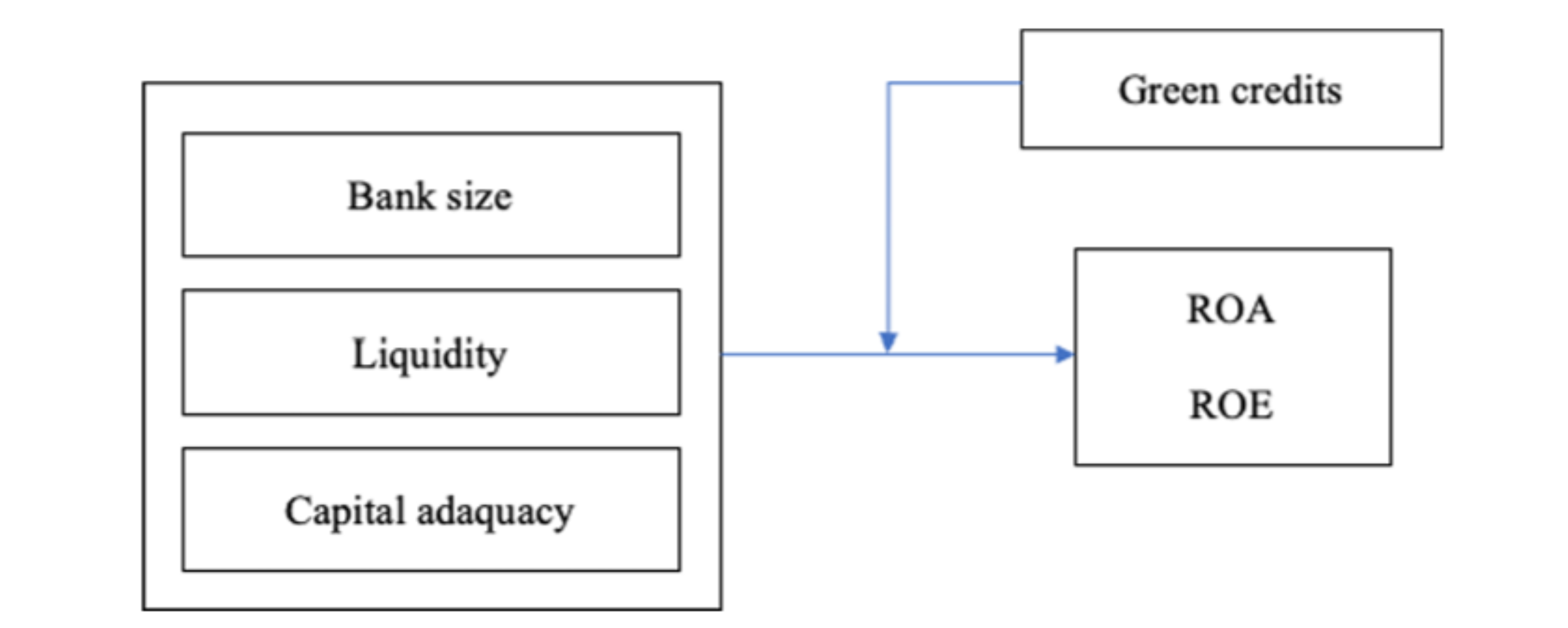
Research Model
Green credit only realizes its value when it becomes part of the bank's development strategy.
From the research results, the authors believe that commercial banks need to proactively build and expand their green credit portfolios as a long-term strategy, rather than merely viewing it as a requirement to meet sustainable development goals. In addition to prioritizing credit allocation for environmentally friendly projects, banks also need to improve the evaluation and risk management processes for green loans, while enhancing the professional capacity of their personnel to implement them more effectively.
From a policy perspective, the research also emphasizes the role of improving the legal framework and mechanisms to support green credit in Vietnam. A clear system of standards, along with appropriate incentive policies, will help banks boldly expand green credit, contributing to both enhancing the operational efficiency of the banking system and promoting the sustainable growth goals of the economy.
The research indirectly contributes to SDG 8, 9, and 13. View the full research paper “How do the green credits affect profitability performance of commercial banks? - Evidence in Vietnam” HERE
The authors: Nguyen Tran Bao Tram, Trinh Yen Ha, Ta Vu Anh Thu, Pham Hoang My Uyen - University of Economics Ho Chi Minh City.
This article is part of the Green Research Community series with the message “Research Contribution for UEH Living Lab Green Campus” UEH sincerely invites the community to follow the next Green Research Community newsletter.
|
*To create maximum conditions for the development of the “UEH Green Researcher Community” members of the community will be able to attend scientific research methods classes related to the topics of Living Lab and Green Campus. Additionally, upon meeting the standards, the research team will receive a certificate from the UEH Sustainable University Project Board and financial support for a standard-compliant project. |
More Information:
SDG 8 – Decent Work and Economic Growth focuses on building an inclusive economy that generates quality, fair, and sustainable jobs for all. This is not only about driving GDP growth but also about improving working conditions, expanding opportunities for youth and women, encouraging innovation, and developing businesses that integrate social responsibility.
SDG 9 – Industry, Innovation, and Infrastructure aims to build resilient infrastructure, promote sustainable industrialization, and encourage innovation. This goal goes beyond advancing technology and production; it also includes narrowing infrastructure access gaps between regions, supporting small and medium-sized enterprises, and applying technology to enhance global competitiveness.
SDG 13 – Climate Action calls for urgent measures to combat climate change and its adverse impacts by reducing greenhouse gas emissions, enhancing adaptive capacity, and raising public awareness. This goal goes beyond national-level policies and requires changes in individual and community behaviors in daily life, especially in areas directly linked to waste generation and management.
News, photos: UEH Green Campus Project, UEH Youth Union - Student Association, UEH Communications and Partnership Development Department
Voiceover: Thanh Kieu

