






12/03/2026
Share

Keywords: Green human resource management, green psychological atmosphere; empowering employees with green initiatives; green commitment; environmentally friendly behavior.
In the context of climate change and increasingly urgent environmental issues, many businesses are striving to transform toward green and sustainable development. But besides technology or strategy, a less noticed factor plays a very important role: the daily behaviors of employees within the organization. When each individual proactively saves resources, minimizes waste, or participates in environmental protection initiatives, these seemingly small actions can create significant changes in the company's journey toward sustainable development.
From that perspective, a group of students from the University of Economics Ho Chi Minh City (UEH) conducted a study titled "Green human resource for the future: The impact of green human resource management on pro-environmental behavior of employees in manufacturing enterprises in Ho Chi Minh City", aiming to understand how green-oriented human resource management policies can promote environmentally friendly behaviors among employees.
What makes employees willing to take action for the environment?
*Starting with how businesses manage people in an environmentally friendly way
One of the important starting points is how businesses design and implement human resource policies with an environmental protection orientation. When "Green" factors are integrated into recruitment, training, or employee evaluation activities, businesses not only convey a message about environmental responsibility but also gradually shape a new awareness within their workforce. When employees understand that environmental protection is also part of the organization's development orientation, they will be more inclined to proactively engage in environmentally friendly actions in their daily work.
*Employees' perceptions in the role of green transformation
Besides organizational policies, employees' perceptions of the work environment also play a very important role. When businesses create an atmosphere that encourages green values, where environmental protection efforts are recognized and supported, employees will easily feel that they are part of the change. Especially when they are empowered to propose ideas, participate in green initiatives, or actively address environmental issues at work, the motivation to engage in environmentally friendly behaviors also becomes stronger.
*The transformation of green actions into personal commitments
From such policies and working environments, another important factor gradually takes shape: the commitment of employees to the organization's environmental protection goals. When employees feel that the green values of the business are also something they believe in and want to contribute to, environmentally friendly behaviors will no longer be just an organizational requirement, but will become the voluntary choice of each individual. It is this commitment that helps green behaviors be maintained sustainably in daily work.
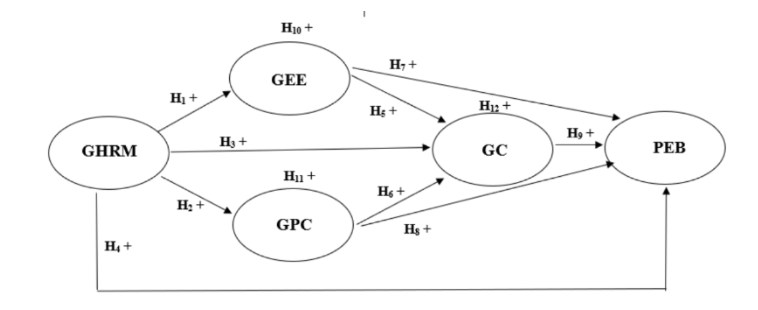
Research Model
Green HR strategies become a driving force for sustainable change
From the research results, it can be seen that if organizations want to promote environmentally friendly behaviors, they need to start with their own human resource management practices. Instead of just stopping at environmental protection messages, green factors need to be integrated into human resource activities such as recruitment, training, or performance evaluation. When these orientations are implemented consistently, employees will gradually realize that environmental protection is not a peripheral activity but a part of the company's development direction.
In addition, businesses also need to create a work environment that encourages green values. When employees feel that the organization truly values environmental protection activities and is willing to recognize their contributions, they will be more inclined to actively participate in green initiatives in their daily work. Such a work atmosphere not only helps raise environmental awareness but also encourages employees' proactivity and creativity in seeking eco-friendly solutions.
Moreover, empowering employees in environmental activities also plays an important role. When employees are encouraged to come up with ideas, participate in solving environmental issues, or propose green initiatives, they will feel that they truly have a role in the organization's transformation process. This not only helps increase employee engagement with the business but also contributes to the formation of environmentally friendly behaviors in a natural and lasting way.
From a broader perspective, when green HR policies are implemented in a synchronized and sustainable manner, they not only contribute to changing employee behavior but also help the business build an image of an organization responsible for the environment and society. And it is precisely from the small actions of each individual within the organization that larger changes in the journey toward sustainable development of the business can gradually take shape.
The research has indirectly contributed to SDG 8, 12, and 13. View the full research paper “Green human resource for the future: The impact of green human resource management on pro-environmental behavior of employees in manufacturing enterprises in Ho Chi Minh City” HERE
Authors: Nguyen Quynh Nhi, Nguyen Hoang Minh Anh, Trinh Thi My Chi, Nguyen Duong Khanh Vu, Tang Huyen Bao Tran - University of Economics Ho Chi Minh City.
This article is part of the Green Research Community series with the message “Research Contribution for UEH Living Lab Green Campus”. UEH sincerely invites the community to follow the next Green Research Community newsletter.
|
*To create maximum conditions for the development of the “UEH Green Researcher Community”, members of the community will be able to attend scientific research methods classes related to the topics of Living Lab and Green Campus. Additionally, upon meeting the standards, the research team will receive a certificate from the UEH Sustainable University Project Board and financial support for a standard-compliant project. |
More Information:
SDG 8 – Decent Work and Economic Growth focuses on building an inclusive economy that generates quality, fair, and sustainable jobs for all. This is not only about driving GDP growth but also about improving working conditions, expanding opportunities for youth and women, encouraging innovation, and developing businesses that integrate social responsibility.
SDG 12 – Responsible Consumption and Production focuses on ensuring sustainable production and consumption patterns, thereby reducing pressure on natural resources, minimizing waste, and limiting environmental pollution. This goal emphasizes the importance of effective waste management, optimal use of resources, and promoting changes in consumer behavior at both individual and community levels, particularly through education and awareness.
SDG 13 – Climate Action calls for urgent measures to combat climate change and its adverse impacts by reducing greenhouse gas emissions, enhancing adaptive capacity, and raising public awareness. This goal goes beyond national-level policies and requires changes in individual and community behaviors in daily life, especially in areas directly linked to waste generation and management.
News, photos: UEH Green Campus Project, UEH Youth Union - Student Association, UEH Communications and Partnership Development Department
Voiceover: Thanh Kieu

