





20/11/2026
Share

Keywords: Place branding; Saigon Riverside Park; Thu Duc City; public spaces; sustainable urban development.
In today’s evolving urban economy and city marketing landscape, place branding is playing an increasingly vital role in shaping the identity and appeal of urban spaces. Modern cities are no longer just competing on infrastructure or investment capital; they’re competing on image, experience, and the quality of life they offer to both residents and visitors. While place branding has been widely studied at the city and tourism levels, there’s still a notable gap in research on how riverside parks in rapidly developing urban areas can be strategically branded to strengthen urban identity, boost visitor engagement, and drive economic sustainability. Addressing this, a research team of students from the University of Economics Ho Chi Minh City (UEH) has proposed a branding strategy for Saigon Riverside Park in Thu Duc City, aiming to turn it into a dynamic, sustainable, and community-connected urban destination.
The goal of this study is to develop a branding strategy for Saigon Riverside Park in Thu Duc City, positioning it as a vibrant, sustainable, and community-centric urban hub. To achieve this, the research takes a multidimensional approach that integrates theories of city branding, marketing strategy, stakeholder engagement, and sustainable urban development. Through case study analysis, empirical data, and strategic recommendations, the authors put forward a comprehensive branding framework. Not only is this framework tailored to the unique characteristics of Saigon Riverside Park, but it also serves as a practical reference model for branding other urban green spaces, striking a balance between economic, environmental, and cultural goals.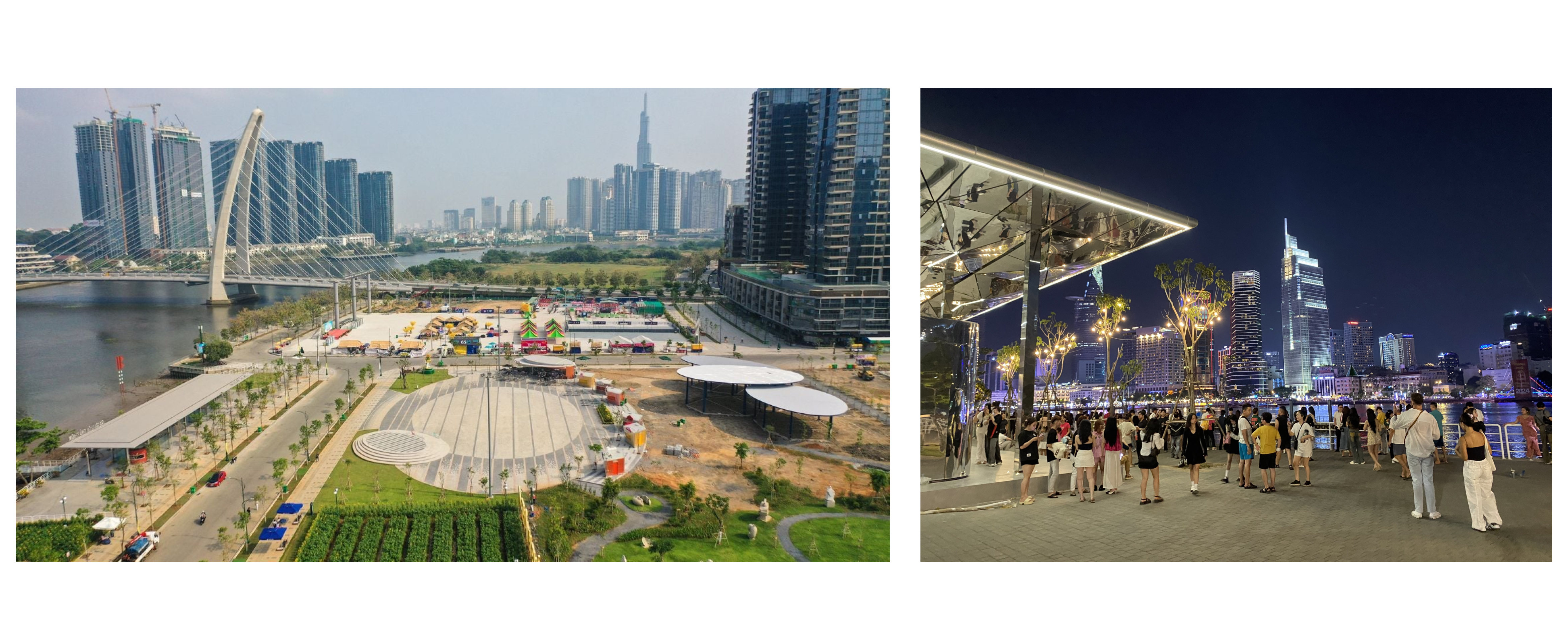
Saigon Riverside Park
Source: Collected
Key Elements of the Branding Strategy
First up are brand identity and brand positioning, which serve as the foundation for the entire strategy. Brand identity captures the unique traits that set the park apart from other green spaces in the city, built on its strategic location, well-designed amenities, and sustainability initiatives. Building on that foundation, brand positioning establishes the exact image the park wants to hold in the minds of locals and visitors: a vibrant, modern, and community-oriented urban space. The study shows that when identity and positioning are clearly defined, the park’s dynamic appeal gets a major boost, helping visitors see it not just as a place to unwind, but as a destination with its own distinct character.
Next, we have communication strategy and digital engagement, which bring that brand image directly to the public. Initiatives like social media campaigns, live events, and collaborations with influencers have significantly raised the park's profile while fostering real community connection and participation. At the same time, integrating smart technology and green initiatives transforms the park into a forward-thinking, environmentally responsible space that aligns with contemporary urban development trends. These two elements work hand in hand: strategic communication expands the brand’s reach, while smart tech and sustainability provide authentic, meaningful substance worth sharing.
Research Findings
The findings confirm that the city branding project for Saigon Riverside Park holds tremendous potential to transform it into a premier destination that resonates with both locals and tourists. By applying strategic city branding principles, the project successfully highlights the park's distinct features and positions it as a vibrant, modern, and community-centric urban space. Establishing a clear brand identity and positioning, combined with its strategic location and thoughtfully designed amenities, has created a dynamic appeal for the entire area.
Beyond that, a customer-centric approach enables the park to meet the expectations of diverse visitor groups, from local families and fitness enthusiasts to tourists. This is crucial because a public space only truly thrives when it serves multiple demographics with varying needs. Marketing and promotional strategies, including social media campaigns, live events, and influencer collaborations, have significantly boosted the park's visibility while fostering genuine community participation. Integrating smart technology and sustainability initiatives has also shaped the perception of the park as a forward-thinking and environmentally responsible space.
Drawing from these results, the study concludes that effective branding for public parks requires a holistic approach that weaves together technological innovation, community engagement, cultural storytelling, and experiential marketing. A public space's brand cannot rely solely on isolated elements like promotional visuals or physical facilities; instead, it requires all these components working in harmony. With its prime location, diverse amenities, and green initiatives, Saigon Riverside Park can stand as a reference model for urban regeneration and place branding across emerging cities.
Policy Implications
First and foremost, it is essential to maintain ongoing interaction and gather continuous feedback from visitors and the local community. This is the study's primary recommendation to ensure the long-term effectiveness and sustainability of the branding strategy. A place brand is never a one-and-done product; it must evolve alongside the changing needs and expectations of its users. When feedback channels remain consistently active, management teams can quickly pinpoint the park's strengths and weaknesses to refine their services, while giving the community a stronger sense of being heard and connected.
Additionally, governing bodies and park operators should continue championing a customer-centric approach while ramping up communications and event programming. Designing amenities and activities around the specific needs of different groups, whether local families, athletes, or tourists, ensures the park can accommodate everyone simultaneously. At the same time, blending social media campaigns, community events, and influencer partnerships remains a powerful way to sustain public awareness and interest.
Finally, there needs to be a stronger push to integrate smart technology and sustainability initiatives into daily park operations. This helps maintain the park's image as a forward-looking, eco-friendly urban space aligned with modern urban development trends. When sustainability is consistently reflected across design, operations, and communications, the park not only elevates its brand value but also directly contributes to the city's broader sustainable urban development goals.
Ultimately, this research enriches ongoing discussions around urban branding while offering a practical, flexible framework for policymakers, urban planners, and marketing professionals. This branding model can easily be adapted for other green spaces, boosting the competitiveness and quality of life of urban environments within today's evolving urban economy.
The study has indirectly contributed to SDGs 9, 11, and 17. Read the full study “Place branding strategy for the park area along the Saigon river, Thu Duc City: An innovative approach within the new urban economy and city marketing context” HERE
The author: Nguyen Viet Quoc Hung - University of Economics Ho Chi Minh City.
This article is part of the Green Research Community series with the message “Research Contribution for UEH Living Lab Green Campus” UEH sincerely invites the community to follow the next Green Research Community newsletter.
|
*To create maximum conditions for the development of the “UEH Green Researcher Community” members of the community will be able to attend scientific research methods classes related to the topics of Living Lab and Green Campus. Additionally, upon meeting the standards, the research team will receive a certificate from the UEH Sustainable University Project Board and financial support for a standard-compliant project. |
More Information:
SDG 9 – Industry, Innovation, and Infrastructure aims to build resilient infrastructure, promote sustainable industrialization, and encourage innovation. This goal goes beyond advancing technology and production; it also includes narrowing infrastructure access gaps between regions, supporting small and medium-sized enterprises, and applying technology to enhance global competitiveness.
SDG 11 – Sustainable Cities and Communities seeks to develop urban areas and communities that are resilient, safe, and sustainable by improving living environments, managing waste effectively, and ensuring access to basic services for all citizens. A sustainable city is not only about physical infrastructure but also about raising awareness and shaping residents’ behavior to protect their shared environment.
SDG 17 – Partnerships for the Goals highlights the role of international cooperation in successfully achieving the Sustainable Development Goals. This goes beyond financial support or technology transfer; it involves coordination in policy, trade, science, and knowledge among nations, regions, and global organizations. Strong partnerships will be the key to transforming shared goals into tangible actions.
News, photos: UEH Green Campus Project, UEH Youth Union - Student Association, UEH Communications and Partnership Development Department

