







09/09/2026
Share

Keywords: Foreign institutional investors; Environmental performance; Sustainable finance; Sustainable development; Corporate governance; Economic freedom.
In the journey toward sustainable development, businesses are not only affected by government policies or consumer pressure but also by those who hold investment capital. As environmental criteria increasingly become a measure of competitiveness, a question arises: can investors become a driving force for businesses to operate more sustainably, or are they simply seeking financial profits?
From that perspective, a group of students from the University of Economics Ho Chi Minh City (UEH) conducted a study titled "Moving towards sustainable development: lessons from global study about the role of foreign institutional investors in environmental performance" Through data from over 19,000 business observations in 28 countries during the period 2002–2018, the study provides empirical evidence of the role of foreign investment flows in promoting environmental performance, while also indicating the conditions that strengthen or weaken this impact.
In recent years, the concept of sustainable investment has been mentioned more frequently. Instead of only focusing on profitability, many investment funds, pension funds, and international financial organizations have begun to consider how businesses interact with the environment and society before deciding to invest. These organizations are collectively referred to as foreign institutional investors – investors who not only bring capital but also governance standards and expectations for sustainable development.
At the same time, environmental performance has also become an important measure of a business. This concept not only reflects the company's efforts to reduce emissions or save resources but also demonstrates their efforts in waste management, efficient energy use, and implementing environmentally friendly development strategies. In the context of businesses facing increasing pressure from the market and society, the question arises: does the presence of foreign institutional investors truly encourage businesses to pay more attention to environmental goals?
What makes investment flows a driving force for green development?
Research results show that the participation of foreign institutional investors has a positive impact on the environmental performance of businesses. In addition to financial resources, this group of investors also brings governance standards and expectations for sustainable development, thereby encouraging businesses to enhance transparency, strengthen environmental responsibility, and pursue long-term development strategies. As environmental criteria increasingly weigh in investment decisions, improving green operations also becomes a way for businesses to attract capital and strengthen the trust of international investors.
However, the level of impact also depends on the institutional context of each country. The study indicates that in countries applying the Common Law system, the influence of foreign institutional investors on the environmental performance of businesses tends to be weaker. This result shows that the same flow of capital, when operating in different legal environments, can create different levels of impact. The institutional system, therefore, plays a crucial role in shaping how businesses perceive and respond to investors' expectations of sustainable development.
This impact is also uneven among businesses. In businesses that already have high operational efficiency or possess many growth opportunities, the driving role of foreign institutional investors tends to diminish. With a relatively solid financial foundation and development orientation, the environmental decisions of this group of enterprises often depend less on external influences. Conversely, in businesses with significant room for improvement, the presence of foreign institutional investors can create additional pressure and motivation to transform operations toward greener, more transparent, and sustainable practices.
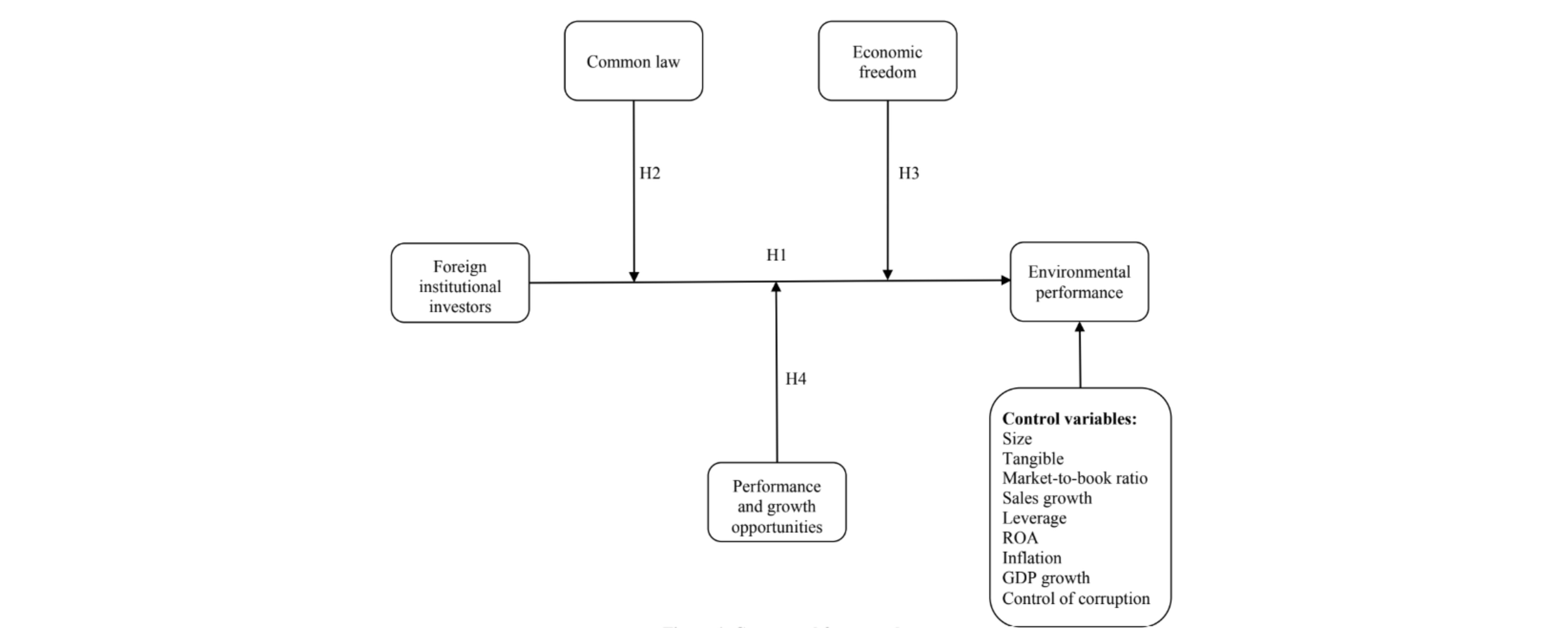
Research Model
From international capital flows to sustainable development drivers
Research shows that foreign investment not only has financial significance but can also become a tool to encourage businesses to enhance their environmental performance. This suggests that businesses need to proactively develop more sustainable and transparent strategies in their environmental activities to increase their attractiveness to international investors. At the same time, policymakers also need to continue improving the institutional environment and encouraging responsible investment activities, thereby better leveraging the role of international capital flows in promoting green growth and sustainable development.
The research paper has indirectly contributed to SDG 12, 13, 17. View the full research paper “Moving towards sustainable development: lessons from global study about the role of foreign institutional investors in environmental performance” HERE
The authors: Hoang Phuong Linh, Thuong Nguyen Tra Giang - University of Economics Ho Chi Minh City.
This article is part of the Green Research Community series with the message “Research Contribution for UEH Living Lab Green Campus” UEH sincerely invites the community to follow the next Green Research Community newsletter.
|
*To create maximum conditions for the development of the “UEH Green Researcher Community” members of the community will be able to attend scientific research methods classes related to the topics of Living Lab and Green Campus. Additionally, upon meeting the standards, the research team will receive a certificate from the UEH Sustainable University Project Board and financial support for a standard-compliant project. |
More Information:
SDG 12 – Responsible Consumption and Production focuses on ensuring sustainable production and consumption patterns, thereby reducing pressure on natural resources, minimizing waste, and limiting environmental pollution. This goal emphasizes the importance of effective waste management, optimal use of resources, and promoting changes in consumer behavior at both individual and community levels, particularly through education and awareness.
SDG 13 – Climate Action calls for urgent measures to combat climate change and its adverse impacts by reducing greenhouse gas emissions, enhancing adaptive capacity, and raising public awareness. This goal goes beyond national-level policies and requires changes in individual and community behaviors in daily life, especially in areas directly linked to waste generation and management.
SDG 17 – Partnerships for the Goals highlights the role of international cooperation in successfully achieving the Sustainable Development Goals. This goes beyond financial support or technology transfer; it involves coordination in policy, trade, science, and knowledge among nations, regions, and global organizations. Strong partnerships will be the key to transforming shared goals into tangible actions.
News, photos: UEH Green Campus Project, UEH Youth Union - Student Association, UEH Communications and Partnership Development Department
Voiceover: Thanh Kieu

