






12/05/2026
Share

Keywords: CO2 emissions; Foreign Direct Investment (FDI); Industrialization; Economic growth; OECD; Kuznets curve; Sustainable development.
In the process of integration, economic growth and industrialization are often assumed to come at the expense of environmental quality. However, does the prosperity of a nation necessarily come with an increase in CO2 emissions, or will the economic potential achieved become the "key" to reversing the situation?
In search of an answer to this question, a group of students from the University of Economics Ho Chi Minh City (UEH) conducted a study titled "Examining the Influence of Foreign Direct Investment, Industrialization, and Economic Variables on CO2 Emissions in OECD Nations: Insights and Implications for Vietnam." By decoding the emission landscape in 33 advanced economies, the study provides strategic implications, helping Vietnam avoid the "pollution trap" on its journey to attract FDI and develop.
Many studies suggest that the relationship between economic growth and the environment often follows an "inverted U-shaped curve," also known as the "Kuznets Curve," which typically prioritizes industrialization to boost the economy. Factories appear more frequently, production expands faster, and energy demand also increases significantly. This causes CO2 emissions and environmental pollution levels to increase in line with economic growth.
However, as the economy develops to a higher level, this trend begins to reverse. Countries gradually shift toward less polluting industries such as services and technology, while also having more resources to invest in clean energy, green technology, and stricter environmental protection policies. Therefore, even tho the economy continues to grow, the level of negative impact on the environment tends to gradually decrease instead of continuously increasing.
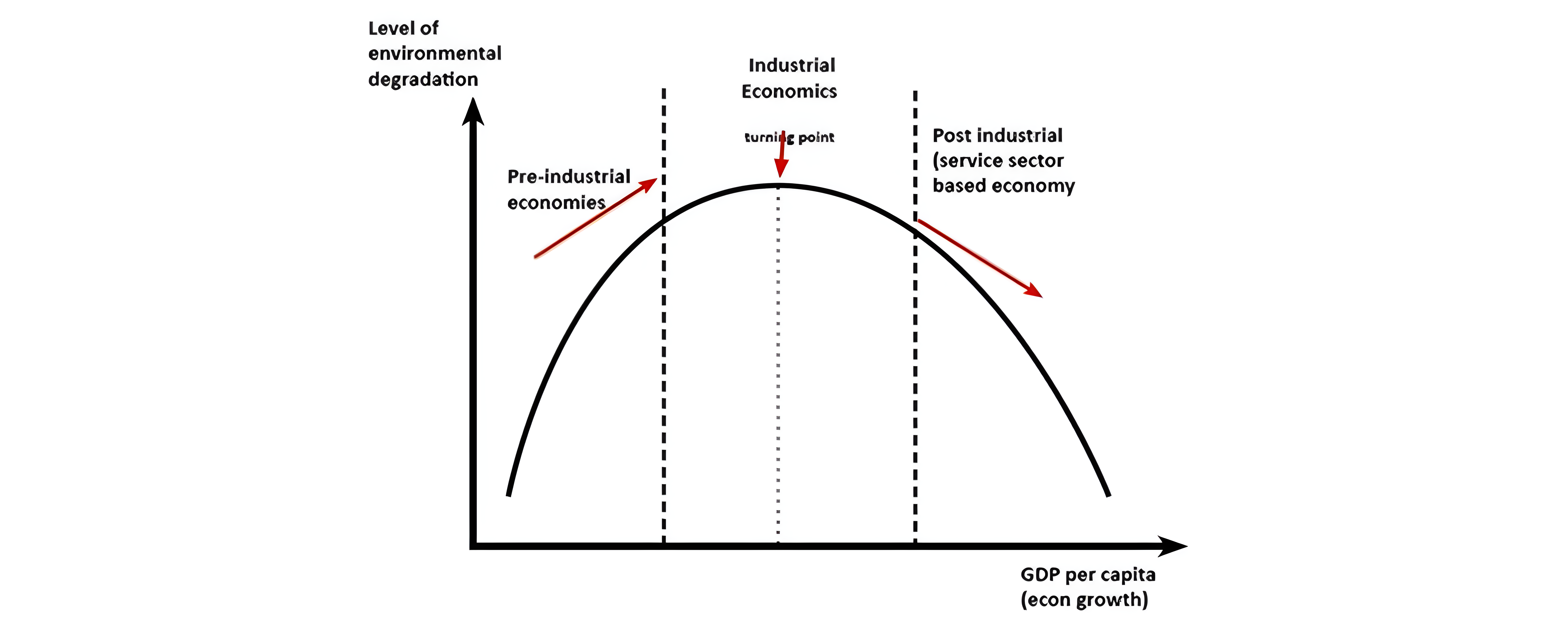 Model of Kuznets Curve Theory
Therefore, OECD countries, a group of the world's leading developed economies such as the United States, the United Kingdom, Japan, and South Korea, become suitable subjects to verify this relationship. These are all countries that have undergone a strong industrialization process, attracted a large amount of foreign investment, and achieved high economic growth for many years. Studying these countries will help clarify whether, when the economy reaches a certain stage of development, environmental pressure continues to increase or if these countries have begun to transition to a more sustainable growth model.
So what is really determining the CO2 emissions of developed countries: economic growth, industrialization, or foreign direct investment?
*The environmental impact varies among different sources of FDI
One of the most notable findings of the study is that total foreign direct investment (FDI) does not significantly impact CO2 emissions. However, FDI directed toward the industrial sector significantly increases emissions. This shows that the issue is not whether a country attracts foreign investment, but rather which sectors the capital is directed toward. When capital flows focus on industrial production, energy demand, production activities, and emission levels also increase.
*The relationship between the scale of the economy and the level of ecological degradation is not always proportional
The study also shows that per capita GDP has a reducing effect on CO2 emissions in OECD countries. This result accurately reflects the logic of the "Kuznets Curve," where countries that reach higher levels of development tend to invest more in clean technology, renewable energy, and stricter environmental policies. Instead of continuing to rely on highly polluting industries, the economy is gradually shifting toward more sustainable sectors such as services, technology, and production.
*Economic growth still comes with environmental pressure if lacking sustainable direction
However, research still indicates that as GDP and population increase, CO2 emissions also tend to rise accordingly. When the economy expands, the demand for consumption, transportation, energy, and production all increase significantly, leading to greater pressure on the environment. This shows that economic growth does not automatically equate to sustainable development, especially if the country still relies on energy-intensive and high-emission production models.
*What matters is not just rapid development, but the direction of that development
From the research results, it can be seen that the core issue is no longer whether countries should develop economically, but rather which growth model to choose for the future. Countries that have been more successful in controlling emissions are often those that know how to transition to clean technology, tighten environmental regulations, and direct investment flows into more sustainable sectors rather than just prioritizing growth at any cost.
What solutions are there for the growth and environment dilemma?
Thru research, the authors believe that developing countries like Vietnam need to focus more on the quality of growth rather than just the speed. Attracting foreign investment still plays an important role in the economy, but priority should be given to capital sources linked to clean technology, low emissions, and industries with minimal negative environmental impact.
In addition, the research also emphasizes the role of renewable energy, public transportation, and environmental policies such as carbon taxes or emissions trading schemes in reducing CO2 levels. Instead of letting the environment become the "price" to pay for economic growth, countries can proactively steer the development process toward a more sustainable direction from the outset.
Especially, research shows that the environmental issue does not only stem from industrialization or economic growth, but also from how countries utilize resources, manage investment flows, and choose long-term development models. This is also the reason why many developed economies are gradually shifting from the goal of "growth at all costs" to "green growth," where the economy and the environment are no longer seen as two opposing goals.
The research paper has indirectly contributed to SDG 8, 9, and 13. View the full research paper “Examining the Influence of Foreign Direct Investment, Industrialization, and Economic Variables on CO2 Emissions in OECD Nations: Insights and Implications for Vietnam” HERE
The authors: Do Hoai Phuong, Trinh Thien Thanh Truc, Le Nguyen Hieu Thao, Le Duc Toan - University of Economics Ho Chi Minh City.
This article is part of the Green Research Community series with the message “Research Contribution for UEH Living Lab Green Campus” UEH sincerely invites the community to follow the next Green Research Community newsletter.
|
*To create maximum conditions for the development of the “UEH Green Researcher Community” members of the community will be able to attend scientific research methods classes related to the topics of Living Lab and Green Campus. Additionally, upon meeting the standards, the research team will receive a certificate from the UEH Sustainable University Project Board and financial support for a standard-compliant project. |
More Information:
SDG 8 – Decent Work and Economic Growth focuses on building an inclusive economy that generates quality, fair, and sustainable jobs for all. This is not only about driving GDP growth but also about improving working conditions, expanding opportunities for youth and women, encouraging innovation, and developing businesses that integrate social responsibility.
SDG 9 – Industry, Innovation, and Infrastructure aims to build resilient infrastructure, promote sustainable industrialization, and encourage innovation. This goal goes beyond advancing technology and production; it also includes narrowing infrastructure access gaps between regions, supporting small and medium-sized enterprises, and applying technology to enhance global competitiveness.
SDG 13 – Climate Action calls for urgent measures to combat climate change and its adverse impacts by reducing greenhouse gas emissions, enhancing adaptive capacity, and raising public awareness. This goal goes beyond national-level policies and requires changes in individual and community behaviors in daily life, especially in areas directly linked to waste generation and management.
News, photos: UEH Green Campus Project, UEH Youth Union - Student Association, UEH Communications and Partnership Development Department
Voiceover: Thanh Kieu

