







08/08/2026
Share

Keywords: Unemployment; CO2 emissions; Climate change; Southeast Asia; Urbanization; Household expenditure; Economic growth; Foreign Direct Investment (FDI).
Unemployment is not only a social welfare issue but also a significant "variable" influencing the CO2 emission landscape – that is the core conclusion drawn from the research topic "Does unemployment affect CO2 emissions? A study in the Southeast Asia region "A study in the Southeast Asian region" by a group of students from the University of Economics Ho Chi Minh City (UEH).
Until now, environmental pressure in developing economies has often been attributed to the process of production expansion or waves of foreign direct investment (FDI). However, by dissecting the macroeconomic data of 9 countries over nearly 3 decades (1991 - 2019), the study uncovered an underlying mechanism: the increase in unemployment rates alters household spending structures and disrupts urbanization trends, thereby indirectly reshaping CO2 emissions. This discovery has shattered traditional thinking, affirming that to achieve sustainable development goals, environmental policies cannot be separated from efforts to stabilize the labor market.
The difference in this study lies in the fact that the authors do not view unemployment in terms of "having a job or not having a job" and then immediately conclude that it affects the environment. Instead, the group posed a more realistic question: How will unemployment change people's lives, and how might those changes affect CO2 emissions?
Imagine, when people lose their jobs, many will start tightening their spending, buying less, and their consumption needs will also change. This could lead to a decrease in production and a change in emissions from economic activities. But on another note, unemployment can also drive many people from rural areas to cities in search of jobs, increasing the demand for transportation, housing, and energy in major urban areas. Therefore, the authors do not consider unemployment to directly impact the environment, but believe it can influence thru two important "links": household spending and urban population, alongside familiar factors such as GDP or foreign direct investment (FDI), which are also closely related to CO2 emissions.
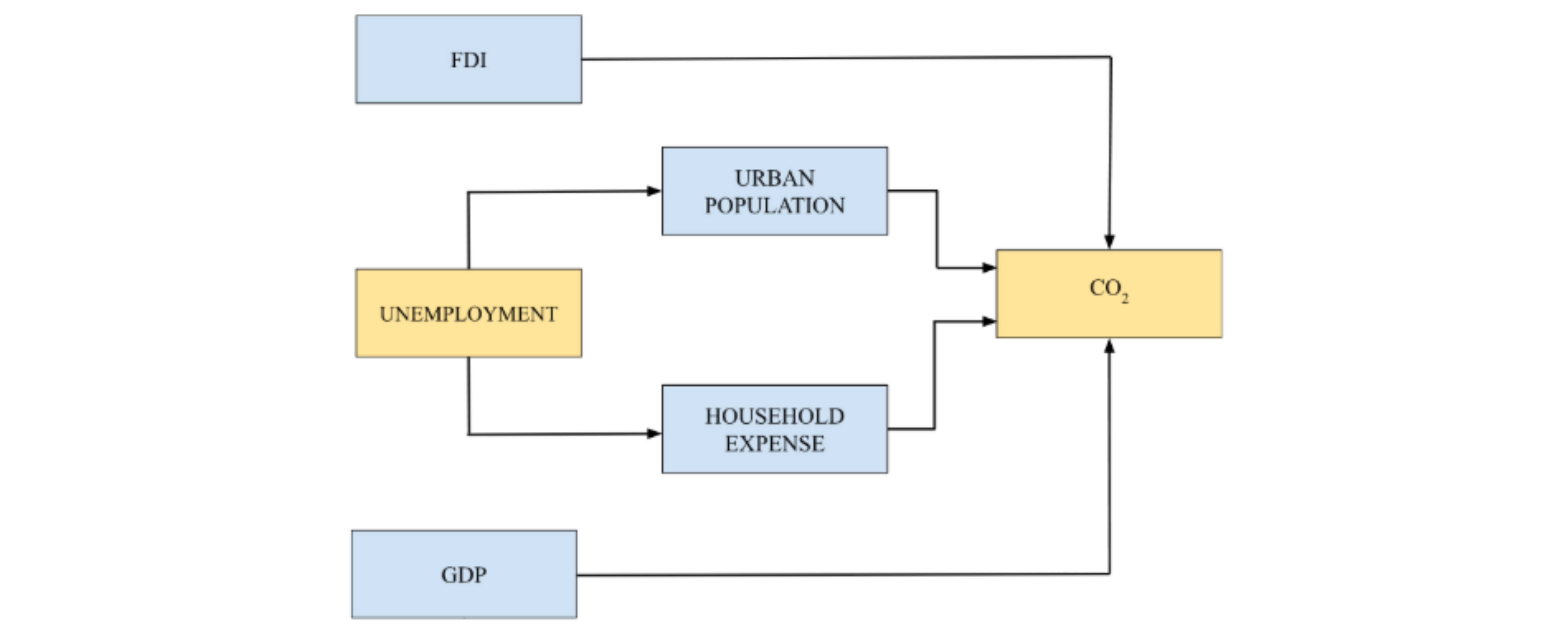
Research Model
So, does unemployment really affect CO2 emissions?
Unemployment does not seem to directly impact the environment in the way many people think, but rather affects it thru changes in socio-economic life. A notable finding of the article is that when the unemployment rate increases, household spending tends to decrease. This is quite understandable, as when income is no longer stable, people tend to prioritize saving more, limit shopping, and cut down on many unnecessary expenses. When consumer demand decreases, the production of goods and services may also slow down, leading to changes in CO2 emissions. However, this impact does not occur immediately but takes time to be clearly reflected in the economy.
Unemployment is also linked to the process of urbanization, a factor considered to have a significant impact on CO2 emissions. Research shows that when job opportunities change, many people tend to move to large urban areas to find work, increasing the urban population. This leads to an increase in demand for transportation, electricity, housing, and consumer activities in the city, thereby affecting carbon emissions. In fact, among the verified factors, the urban population is the variable that shows the most significant impact on CO2 in the short term, indicating that the environmental pressure from urbanization occurs much faster than other changes.
Economic growth and foreign investment remain factors that cannot be overlooked when discussing the environment in Southeast Asia. When GDP increases, production and consumption activities often expand, leading to greater energy demand. Meanwhile, FDI can bring technology and economic growth, but it also carries the risk of increasing emissions if it focuses on energy-intensive or polluting industries. This shows that the environmental issue does not solely depend on a single factor like unemployment, but is the result of multiple economic changes occurring simultaneously.
One noteworthy point is that the impact of unemployment on the environment primarily manifests in the long term rather than the short term. In other words, an increase in the unemployment rate may not immediately change CO2 levels in the first one or two years, but over time, as consumption patterns, population movements, and economic structures begin to change, the impact on the environment becomes more pronounced. This also shows that employment or social welfare policies can actually have a deeper impact on the environment than we might think.
Employment and the environment: Two problems that should not be separated
From the findings of the research, the authors believe that Southeast Asian countries should not view unemployment and environmental protection as two separate issues. Instead, employment policies need to be designed in line with sustainable development, as changes in the labor market can indirectly affect consumer behavior, the pace of urbanization, and ultimately CO2 emissions. In other words, addressing employment is not just a socio-economic issue, but it can also become part of a long-term environmental strategy.
In addition, the study also emphasizes the role of urban planning and controlling the pace of urbanization. As the urban population rapidly increases in search of employment, the pressure on transportation, housing, and energy also grows, leading to a higher risk of emissions. Therefore, countries need to invest in more sustainable urban infrastructure such as public transportation, clean energy, and rational urban planning to mitigate long-term environmental impacts.
Moreover, the authors believe that attracting foreign investment and promoting economic growth should also come with clear environmental standards. Instead of solely focusing on expanding production or increasing GDP at all costs, countries should prioritize sectors that use clean technology, have low emissions, and are more environmentally friendly. This could be a way for Southeast Asia to maintain growth while avoiding a significant trade-off with the quality of the living environment in the future.
The research has indirectly contributed to SDG 8, 11, 13. Read the full research paper "Does unemployment affect CO2 emissions? A study in the Southeast Asia region" HERE.
The authors: Trinh Bich Tuyen, Nguyen Thi Thao, Tran Thanh Truc, Nguyen Hoang Phuc Thien - University of Economics Ho Chi Minh City.
This article is part of the Green Research Community series with the message “Research Contribution for UEH Living Lab Green Campus” UEH sincerely invites the community to follow the next Green Research Community newsletter.
|
*To create maximum conditions for the development of the “UEH Green Researcher Community” members of the community will be able to attend scientific research methods classes related to the topics of Living Lab and Green Campus. Additionally, upon meeting the standards, the research team will receive a certificate from the UEH Sustainable University Project Board and financial support for a standard-compliant project. |
More Information:
SDG 8 – Decent Work and Economic Growth focuses on building an inclusive economy that generates quality, fair, and sustainable jobs for all. This is not only about driving GDP growth but also about improving working conditions, expanding opportunities for youth and women, encouraging innovation, and developing businesses that integrate social responsibility.
SDG 11 – Sustainable Cities and Communities seeks to develop urban areas and communities that are resilient, safe, and sustainable by improving living environments, managing waste effectively, and ensuring access to basic services for all citizens. A sustainable city is not only about physical infrastructure but also about raising awareness and shaping residents’ behavior to protect their shared environment.
SDG 13 – Climate Action calls for urgent measures to combat climate change and its adverse impacts by reducing greenhouse gas emissions, enhancing adaptive capacity, and raising public awareness. This goal goes beyond national-level policies and requires changes in individual and community behaviors in daily life, especially in areas directly linked to waste generation and management.
News, photos: UEH Green Campus Project, UEH Youth Union - Student Association, UEH Communications and Partnership Development Department
Voiceover: Thanh Kieu

