




10/04/2026
Share

Keywords: Gamification; Virtual CSR; Co-creation; Green consumer behavior; Gen Z; User experience; Satisfaction; Enjoyment perception.
In the digital age, when corporate social responsibility (CSR) activities are no longer the exclusive "playground" of businesses but gradually become interactive experiences for users. Can "gamification" make green consumption more appealing to the younger generation?
From that perspective, a group of students from the University of Economics Ho Chi Minh City (UEH) conducted a study titled “The effect of gamified virtual CSR cocreated on green consumption behavior: Research results of Gen Z in Ho Chi Minh City,” aiming to explore how factors such as attitude, satisfaction, and enjoyment perception activated thru gamification can promote the green consumption behavior of Gen Z in the digital context.
So what makes "serious" CSR activities attractive enough to change the behavior of Gen Z in the digital environment?
First, it's not that CSR lacks meaning, but rather that it lacks engaging experiences to retain young people. In the context of increasingly popular CSR activities, the issue does not lie in Gen Z's lack of interest, but in the way these activities are conveyed. CSR integrates game elements such as points, challenges, or leaderboards, transforming the experience from a mere "call to action" into an interactive journey. This transformation helps users not only receive but also actively participate in socially meaningful activities.
Secondly, when the experience becomes enjoyable, a positive attitude begins to take shape. Gamification not only creates novelty but also contributes to changing the way users perceive CSR activities. When the experience becomes engaging and provides a sense of achievement, users tend to develop a more positive attitude toward environmentally related behaviors. This attitude acts as a "psychological bridge," helping to transform awareness into action.
Next, it is not cognition, but emotion that is the factor that retains behavior. The research results show that satisfaction and enjoyment are important mediating factors, with satisfaction playing the strongest role in promoting green consumer behavior. When users feel happy, satisfied, and find meaning in the participation process, they do not just stop at a temporary experience but tend to maintain long-term behavior.
Ultimately, when "playing" brings value, green behavior is no longer an obligation but becomes a natural choice. The combination of entertainment and social significance has changed the way Gen Z approaches green consumption. Instead of feeling "pressured to live green," users are beginning to see it as both an enjoyable and valuable experience. At that point, green consumption behavior is no longer forced but gradually becomes a natural part of their lifestyle.
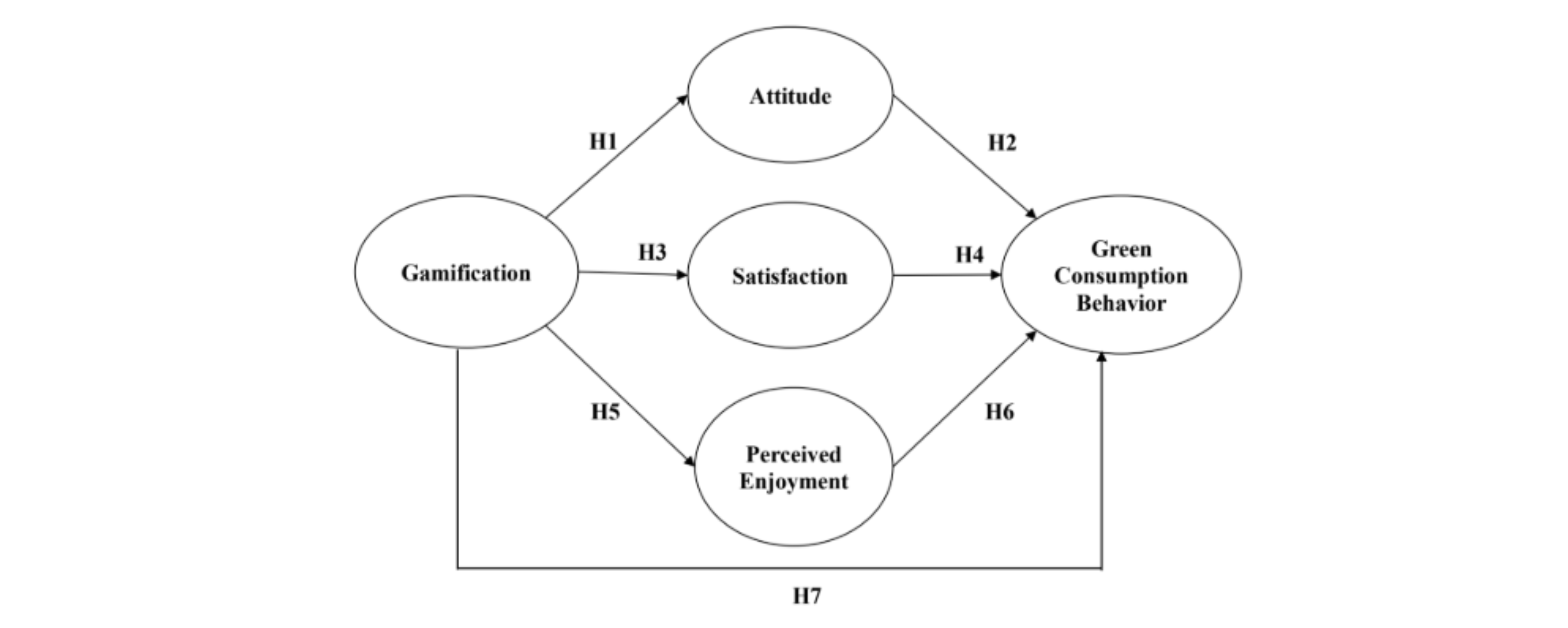 Research Model
It's not enough to just "gamify"; you need to create a meaningful experience to retain users
Thru the research results, it can be seen that gamification does not directly impact green consumer behavior, but rather thru psychological factors such as attitude, satisfaction, and enjoyment, with satisfaction playing the strongest role. This shows that merely getting users to "participate" is not enough; more importantly, they must feel satisfied and valued throughout the entire experience.
From there, businesses need to shift from using gamification as a short-term engagement tool to designing deeper experiences. Elements such as rewards, challenges, or leaderboards only truly become effective when they provide a sense of achievement, joy, and contribution to users, rather than merely serving as entertainment.
Additionally, the implementation of CSR in the digital environment needs to be built toward two-way interaction, where users not only participate but also feel that they are accompanying the business in creating social value. When the experience is interesting and meaningful enough, positive emotions will gradually form, thereby reinforcing attitudes and naturally promoting green consumer behavior.
Ultimately, for green behavior to be sustained in the long term, businesses not only need to attract users to try it out but also make them want to return. And what keeps them engaged is not the "game," but the sense of satisfaction from realizing that each small action of theirs is contributing to a larger impact on the environment.
The research paper has indirectly contributed to SDG 9, 12, and 13. See the full research paper “The effect of gamified virtual CSR cocreated on green consumption behavior: Research results of Gen Z in Ho Chi Minh City” HERE
The authors: Pham Thi Thuy Huong, Nguyen Thi Hong Phan, Pham Thi Duong - University of Economics Ho Chi Minh City.
This article is part of the Green Research Community series with the message “Research Contribution for UEH Living Lab Green Campus” UEH sincerely invites the community to follow the next Green Research Community newsletter.
|
*To create maximum conditions for the development of the “UEH Green Researcher Community” members of the community will be able to attend scientific research methods classes related to the topics of Living Lab and Green Campus. Additionally, upon meeting the standards, the research team will receive a certificate from the UEH Sustainable University Project Board and financial support for a standard-compliant project. |
More Information:
SDG 9 – Industry, Innovation, and Infrastructure aims to build resilient infrastructure, promote sustainable industrialization, and encourage innovation. This goal goes beyond advancing technology and production; it also includes narrowing infrastructure access gaps between regions, supporting small and medium-sized enterprises, and applying technology to enhance global competitiveness.
SDG 12 – Responsible Consumption and Production focuses on ensuring sustainable production and consumption patterns, thereby reducing pressure on natural resources, minimizing waste, and limiting environmental pollution. This goal emphasizes the importance of effective waste management, optimal use of resources, and promoting changes in consumer behavior at both individual and community levels, particularly through education and awareness.
SDG 13 – Climate Action calls for urgent measures to combat climate change and its adverse impacts by reducing greenhouse gas emissions, enhancing adaptive capacity, and raising public awareness. This goal goes beyond national-level policies and requires changes in individual and community behaviors in daily life, especially in areas directly linked to waste generation and management.
News, photos: UEH Green Campus Project, UEH Youth Union - Student Association, UEH Communications and Partnership Development Department
Voiceover: Thanh Kieu

