


03/08/2026
Share

The ocean, which covers more than three-quarters of the Earth’s surface and serves as the planet’s largest carbon sink, is now facing unprecedented challenges. Plastic pollution, ocean acidification, overexploitation, and the impacts of climate change are gradually undermining life below water. When the health of the ocean is threatened, food security, biodiversity, and humanity’s sustainable future are also placed at risk. In this week’s article, Green Monday Series invites readers to explore marine resources and the marine environment through SDG 14 - Life Below Water, together with UEH’s efforts to protect marine resources.
The ocean is the foundation of life on Earth. It covers about 75% of the planet’s surface, contains 97% of global water resources, and absorbs approximately 23% of annual CO₂ emissions. Beyond providing food, medicines, biofuels, and livelihoods for billions of people, the ocean also regulates the climate and acts as the world’s largest carbon reservoir. However, this ecosystem is deteriorating at an alarming rate. In 2021, more than 17 million tons of waste entered the ocean, and this figure could double or even triple by 2040. Each year, an estimated 5 to 12 million tons of plastic flow into the sea, causing economic losses of up to USD 13 billion. Ocean temperatures continue to reach record highs, bringing severe consequences for marine ecosystems. Most notably, the fourth global coral bleaching event affected 84% of the world’s coral reefs during 2023-2025, making it one of the most serious coral degradation events ever recorded. In addition, ocean acidification, overfishing, and coastal pollution continue to threaten biodiversity and global food security.

In this context, SDG 14 is not only about reducing marine pollution and protecting coastal ecosystems. It also aims to end destructive fishing practices, advance marine science, restore biodiversity, and strengthen resilience to climate change. Despite ongoing conservation efforts, only 8.4% of the ocean is currently protected as marine protected areas, and just 46% of key marine biodiversity areas receive official protection. Effective management of marine resources has therefore become an urgent requirement to safeguard ocean health, sustain the livelihoods of millions of fisheries workers, and ensure a sustainable future for generations to come.

On the journey to realizing SDG 14, UEH adopts an approach that combines education, research, and community action to conserve and sustainably use marine resources and the marine environment. Through the “Community Together” program organized by the Institute of Economics and Environment and the Institute of Agricultural and Health Policy Research, UEH has directly supported farmers and fishers in the Mekong Delta with knowledge on efficient water use, climate-resilient farming, and sustainable water resource management. UEH has also implemented projects to promote watershed governance, reduce water pollution, monitor biodiversity, and foster policy dialogue on water resources. These initiatives include the installation of irrigation sensors and community training activities in Cu Lao Dung District, Soc Trang Province. In the fisheries sector, UEH has conducted field research, scientific workshops, and short-term courses on responsible fishing, sustainable aquaculture, and eco-tourism. The university has also collaborated with the World Bank to discuss strategies for sustainable fisheries management through the Green Growth & Climate Modeling program.
In addition, UEH has developed an internal policy framework to minimize impacts on the campus water environment and promote green practices. Under Decision No. 2059/QĐ-ĐHKT-CSVC, UEH is implementing a roadmap to reduce and eventually eliminate single-use plastics, promote the 3R model (Reduce - Reuse - Recycle), and prioritize reusable materials and refill facilities through the “No Single-use Plastic Campus” campaign. UEH also requires the use of biodegradable cleaning products, the replacement of hazardous chemicals with environmentally friendly alternatives, and the development of guidelines and standards for monitoring water quality, wastewater discharge, and the health of aquatic ecosystems. Through waste management at the source, strict control of single-use plastics at events, and cooperation programs to protect shared aquatic ecosystems with local communities, UEH is gradually contributing to biodiversity conservation, water pollution reduction, and sustainable water resource governance in line with the spirit of SDG 14.
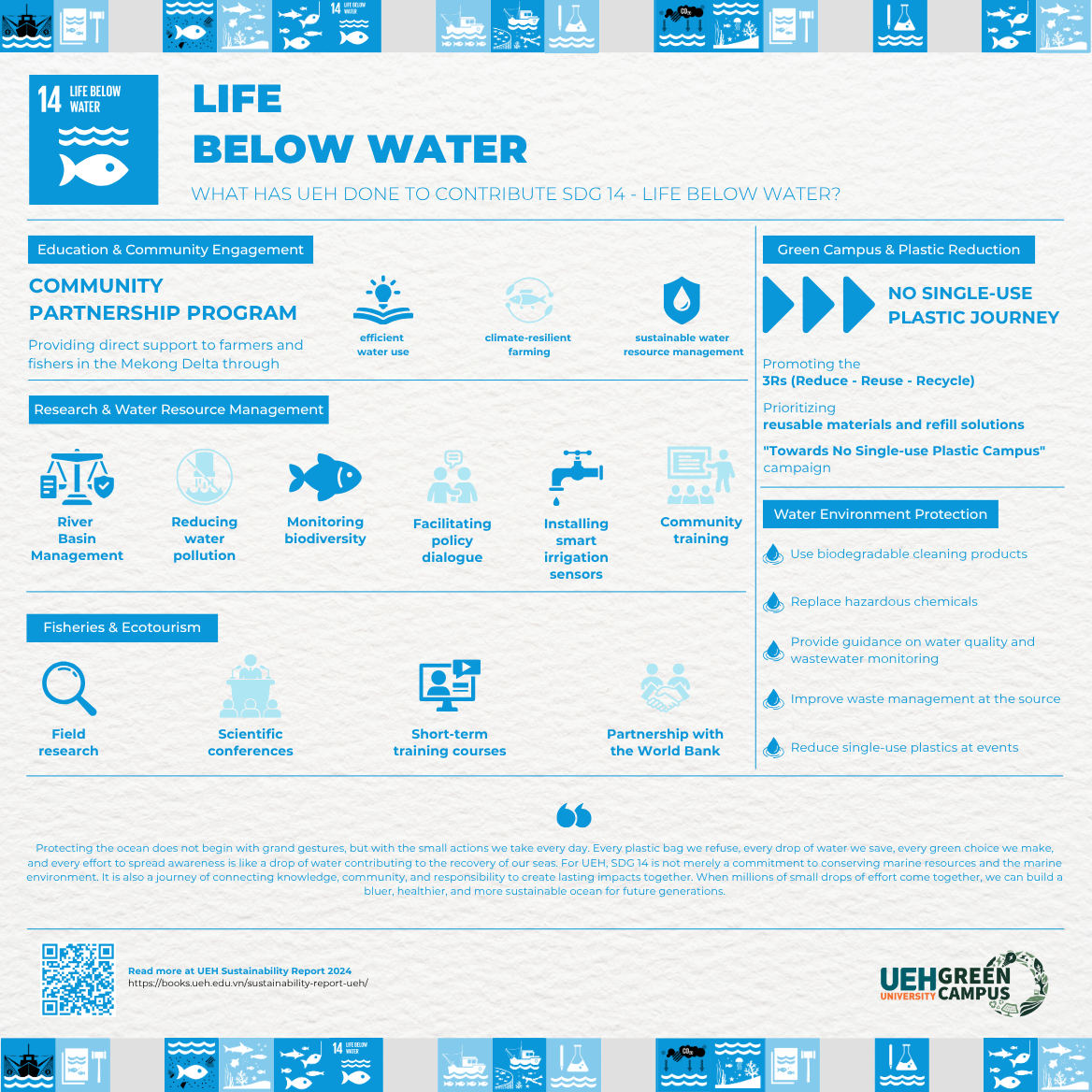
Infographic of UEH's contributions to SDG 14 - Life Below Water
Protecting the ocean does not begin with grand gestures, but with the small actions we take every day. Every plastic bag we refuse, every drop of water we save, every green choice we make, and every effort to spread awareness is like a drop of water contributing to the recovery of our seas. For UEH, SDG 14 is not merely a commitment to conserving marine resources and the marine environment. It is also a journey of connecting knowledge, community, and responsibility to create lasting impacts together. When millions of small drops of effort come together, we can build a bluer, healthier, and more sustainable ocean for future generations.
|
What can we do to contribute to SDG 14?
|
This article was prepared with reference to:
1. UEH Sustainability Report 2024: https://books.ueh.edu.vn/sustainability-report-ueh/
2. SDG 14 - Life Below Water: https://www.un.org/sustainabledevelopment/oceans/
Additional Information:
UEH Green Campus - Green Monday Series is a communication activity series under the UEH Green Campus Project, posted every Monday to start the week with positive energy and encourage a green lifestyle by providing knowledge, updating news, sharing inspiring stories about environmental protection and sustainable development.
News and photos: UEH Green Campus Project