


29/06/2026
Share

A sustainable city is not defined solely by modern buildings and infrastructure; it is also a place that nurtures creativity, fosters social connections, and enhances the quality of life for its communities. In alignment with SDG 11 - Sustainable Cities and Communities, UEH is steadily developing a Green University Campus with open and inclusive spaces through a wide range of initiatives in campus planning, culture, arts, sustainable mobility, and community space development. In this week's edition of the Green Monday Series, let's explore UEH's efforts to build an innovative and sustainable learning environment while spreading positive values to the wider community.
Cities have long been engines of economic growth, innovation, and social development. At the same time, they have become focal points for some of humanity's greatest challenges, including inequality, environmental pollution, climate change, and increasing pressure on infrastructure. The global population reached 8 billion in 2022, with more than half living in urban areas, a proportion projected to rise to approximately 70% by 2050. This trend has created an urgent need for sustainable cities and communities where everyone can access facilities and infrastructure equitably and conveniently. However, the pace of urbanization has outstripped the capacity of many cities, resulting in severe infrastructure overload, shrinking public spaces, and worsening environmental pollution. By 2022, only about half of the world's urban population had access to public transportation, while nearly 3 billion people struggled to afford adequate housing, and approximately 1.12 billion people lived in slums or informal settlements lacking basic services.
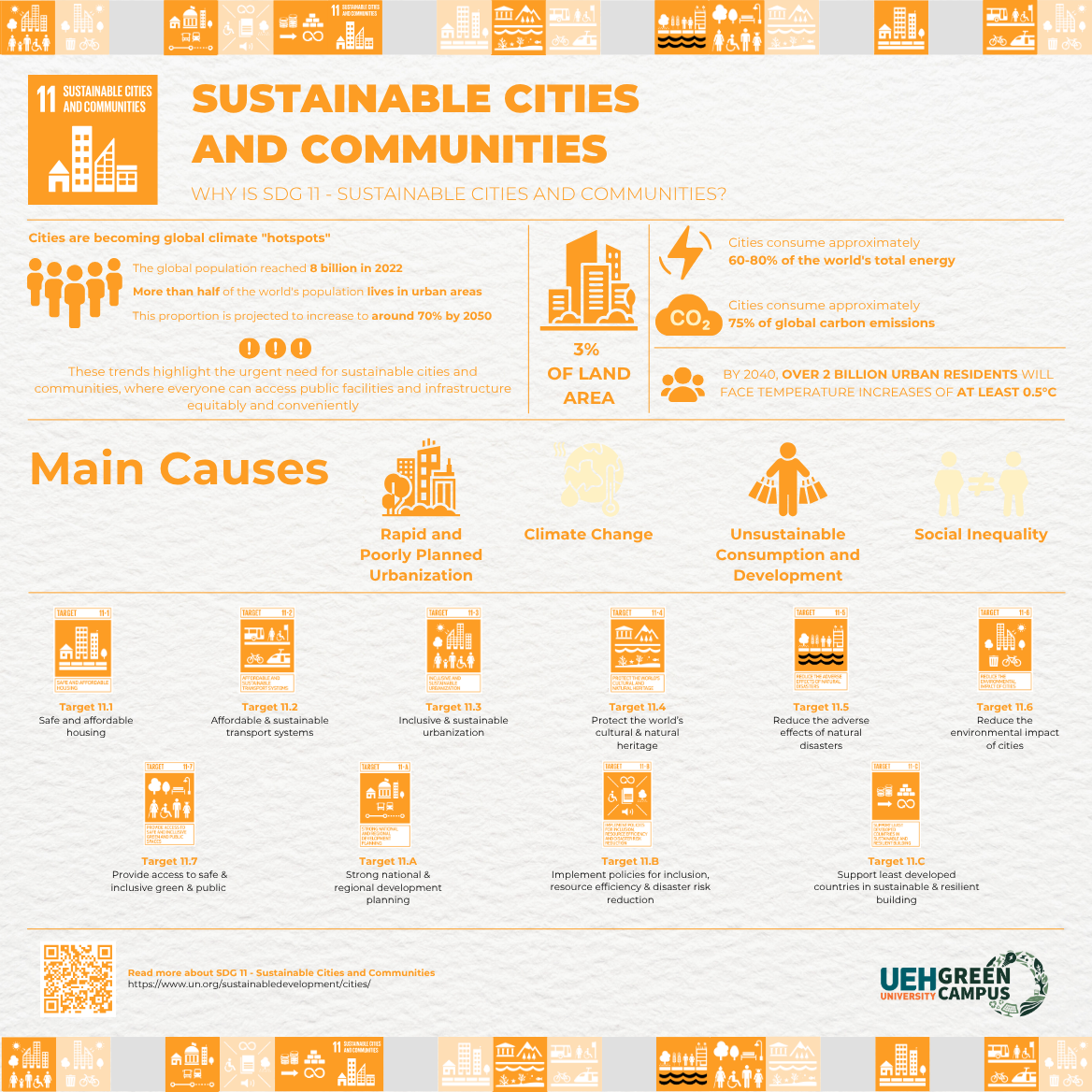
Urban areas are increasingly becoming climate change "hotspots." Although cities occupy only around 3% of the Earth's land surface, they consume approximately 60-80% of the world's total energy and generate about 75% of global carbon emissions. By 2040, more than 2 billion urban residents are expected to experience temperature increases of at least 0.5°C. These figures demonstrate that sustainable urban development is no longer an option but an urgent necessity. Cities must strengthen green urban planning, promote sustainable transportation, develop climate-resilient infrastructure, and expand public spaces to improve the quality of life for everyone.

In support of SDG 11, UEH has implemented a wide range of initiatives to promote sustainable mobility and digital transformation in its operations. Since 2023, the UEH Green Campus Regulations have encouraged students to prioritize environmentally friendly modes of transportation such as walking, cycling, and public transit. As a result, 57.5% of students have chosen sustainable transportation methods, exceeding the 42.5% who rely on private vehicles. Complementing this effort, the UEH Shuttle Bus system has provided more than 74,000 passenger trips, while UEH has further enhanced connectivity with Metro Line No. 1 to encourage students, faculty, and staff to use public transportation. From an academic perspective, UEH has partnered with Hasselt University (Belgium) to implement the Route2School Education Project, which integrates virtual reality (VR) technology and gamification to enhance traffic safety awareness through educational programs. Digital operations have also been expanded, with more than 30% of meetings conducted online or in hybrid formats. In addition, the Student Orientation Week for over 37,000 new students has been delivered entirely through digital platforms, helping reduce travel demand and associated carbon emissions.
At the same time, UEH has promoted campus development based on green, open, smart, and resilient principles while strengthening welfare policies to foster an inclusive and sustainable university community. Between 2022 and 2024, UEH signed 68 cooperation agreements with local governments to co-develop urban planning solutions. The University also introduced the Minimum Green Building Standards (2024), requiring all new buildings larger than 1,000 m² to obtain internationally recognized green building certification. As a result, the MCIE Center reduced its energy consumption by 38% and water consumption by 40%, while the UEH Mekong Dormitory achieved reductions of 42% in energy use and 24% in water consumption. Furthermore, UEH prioritizes development on already urbanized land, maintains a green coverage ratio of approximately 35-45%, contributes to reducing surrounding temperatures by 2-3°C, and improves flood resilience. To ensure an inclusive university community, UEH has also implemented various housing and social welfare support policies. These include VND 212 million in financial assistance for 140 disadvantaged students, nearly VND 1 billion in bus fare subsidies supporting approximately 74,000 passenger trips, free dormitory accommodation for 19 international students, and a monthly housing allowance of VND 1.5 million for staff renting accommodation. These achievements demonstrate UEH's commitment to ensuring that every member of its community has equal opportunities to learn, work, and thrive in a safe, inclusive, and sustainable environment.
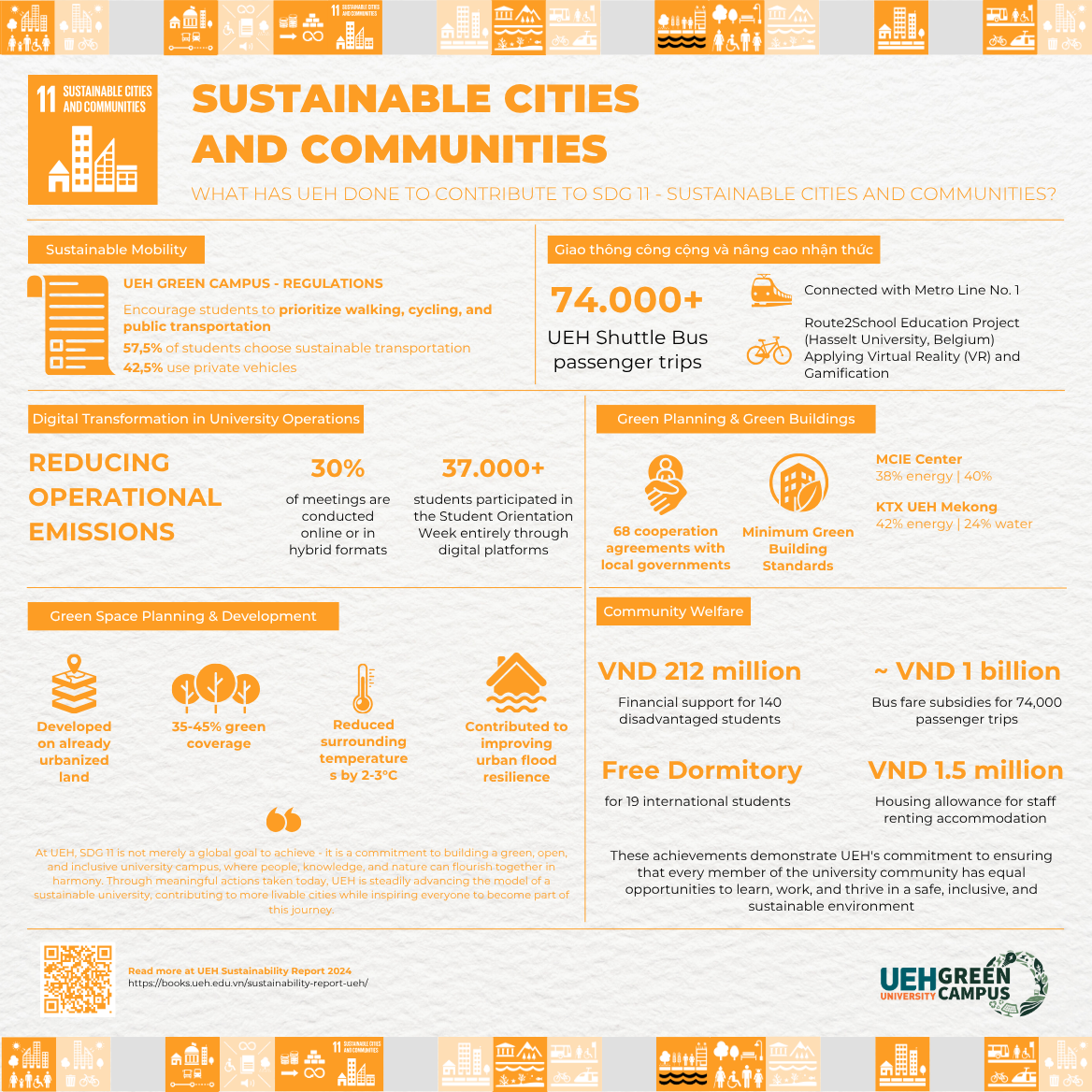
Infographic of UEH's contributions to SDG 11 - Sustainable Cities and Communities
Sustainable development does not begin with large-scale actions alone; it is built through every learning space, every transportation choice, and every action that benefits the community. At UEH, SDG 11 is not merely a global goal to achieve—it is a commitment to creating a green, open, and inclusive university campus where people, knowledge, and nature can flourish together in harmony. Through meaningful actions taken today, UEH is gradually advancing the sustainable university model, contributing to more livable cities while inspiring everyone to become part of this journey.
|
What can we do to contribute to SDG 11?
|
This article was prepared with reference to:
1. UEH Sustainability Report 2024: https://books.ueh.edu.vn/sustainability-report-ueh/
2. SDG 11 - Sustainable Cities and Communities: https://www.un.org/sustainabledevelopment/cities/
Additional Information:
UEH Green Campus - Green Monday Series is a communication activity series under the UEH Green Campus Project, posted every Monday to start the week with positive energy and encourage a green lifestyle by providing knowledge, updating news, sharing inspiring stories about environmental protection and sustainable development.
News and photos: UEH Green Campus Project